

Most bags of coffee on UK shelves carry at least one certification sticker, but very few carry two centuries of sourcing relationships. Ethical coffee sourcing in the UK has become a crowded talking point, with every brand claiming transparency while publishing very little that is specific or verifiable.
Farrer's takes a different position. Founded in Kendal in 1819, the business has been selecting, roasting, and blending coffee long enough to know that ethical sourcing is not a marketing layer you add at launch. It is the slow accumulation of supplier trust, taste knowledge, and principled decisions made across every single buying cycle.
Table of Contents
- Why Ethical Sourcing Matters for Specialty Coffee
- Quick Takeaways
- Farrer's Approach: Trusted Partners and Long-Term Relationships
- Understanding the Certifications: Fairtrade, Rainforest Alliance, and Direct Trade
- Comparison of Ethical Sourcing Models
- From Origin to Kendal: The Specialty Coffee Supply Chain
- What Sustainable Roasting Actually Looks Like
- How to Shop Ethically as a Home Enthusiast or Trade Buyer
- Frequently Asked Questions
- References
Why Ethical Sourcing Matters for Specialty Coffee
Coffee is one of the most traded commodities in the world, and that scale creates enormous pressure on the people at the bottom of the supply chain. Smallholder farmers, often in economically vulnerable regions, can find their livelihoods at the mercy of market price swings they have no control over. When a roaster decides who to buy from, at what price, and under what conditions, those decisions ripple directly into farming communities thousands of miles away.
For home enthusiasts, this matters because what is in your cup is the product of those decisions. For cafes and hospitality businesses, it matters because their customers are increasingly asking the right questions. A 2023 figure from the specialty coffee trade noted that UK coffee exports hit over 92,000 metric tonnes as demand for traceable, ethically sourced beans continued to climb. Buying from a roaster with genuine sourcing values is not an ideological choice. It is a practical one, because traceable supply chains consistently produce better and more consistent quality at the cup level.
Pro tip: When evaluating a roaster's ethical credentials, ask one simple question: can they name the producers or cooperatives their coffee comes from? If the answer is vague, the sourcing relationships probably are too.
Quick Takeaways
| Key Insight | Explanation |
|---|---|
| Long-term supplier relationships drive quality | Farrer's works with trusted producers who share its values, not whoever offers the cheapest beans in a given season. Continuity of relationship equals consistency in the cup. |
| Certifications are a floor, not a ceiling | Labels like Fairtrade and Rainforest Alliance set minimum standards. The best roasters exceed them through direct engagement with producers and transparent buying practices. |
| Small-batch roasting preserves ethical intent | Roasting in considered batches, as Farrer's does, means each origin is treated on its own terms, not blended away into anonymous commodity output. |
| Transparent supply chains improve traceability | Choosing coffees that support transparent supply chains, as Farrer's states in its values, means buyers can follow the bean from farm to roastery. |
| Trade buyers carry ethical responsibility too | Cafes and restaurants that choose a responsibly sourced supplier pass that value directly to their customers, and increasingly, customers notice and reward it. |
| Heritage does not conflict with sustainability | Over 200 years of buying relationships means Farrer's has refined supplier partnerships over generations, not just quarters. That depth is a sourcing advantage. |
| Origin matters to flavour, not just ethics | Single-origin coffees from specific farms or cooperatives carry distinct flavour profiles. Ethical sourcing and great taste are the same thing when done properly. |
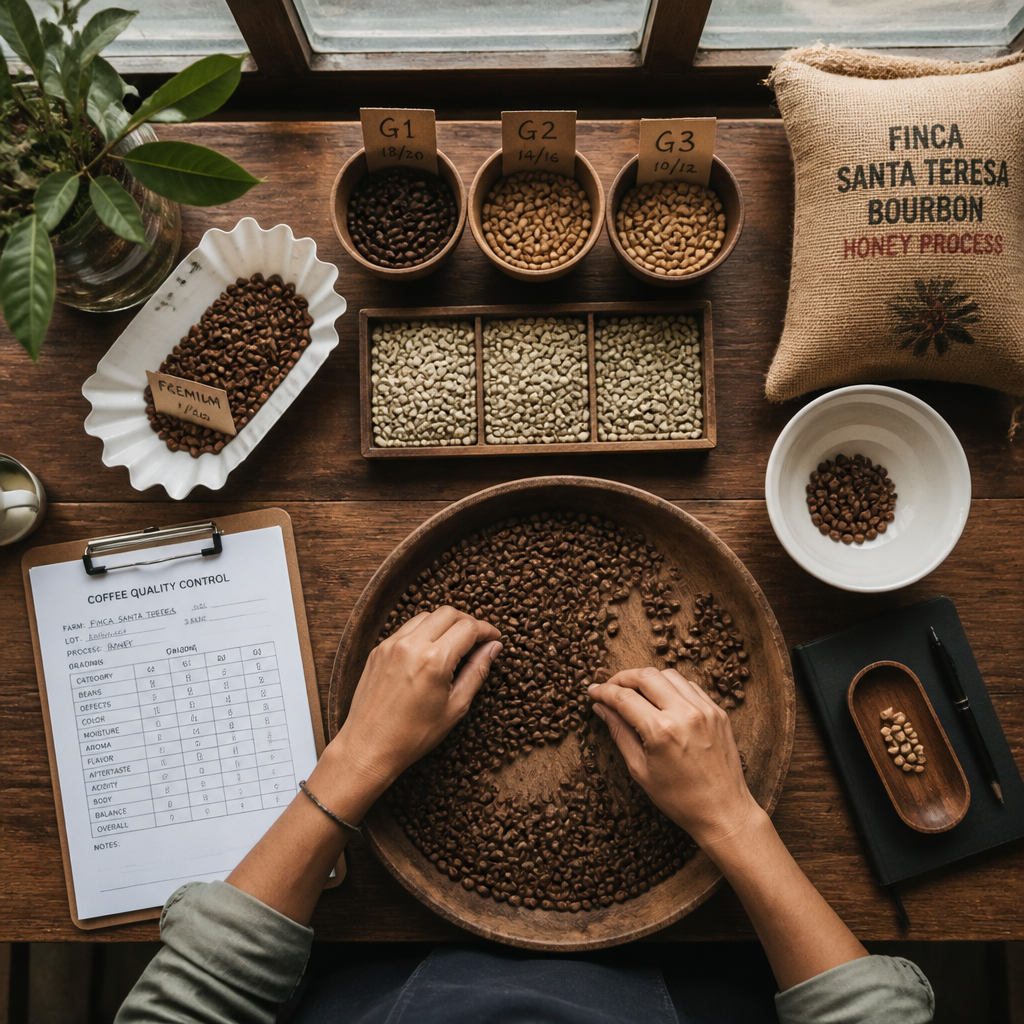
The connection between ethical purchasing and cup quality is one of the most misunderstood ideas in the UK coffee conversation. People sometimes treat the two as separate concerns, one for activists and one for drinkers. In practice, the farms that invest most in soil health, careful picking, and post-harvest processing are usually the same farms that benefit most from fair prices and stable buyer relationships. Farrer's understanding of this is baked into over two centuries of buying practice.
Farrer's Approach: Trusted Partners and Long-Term Relationships
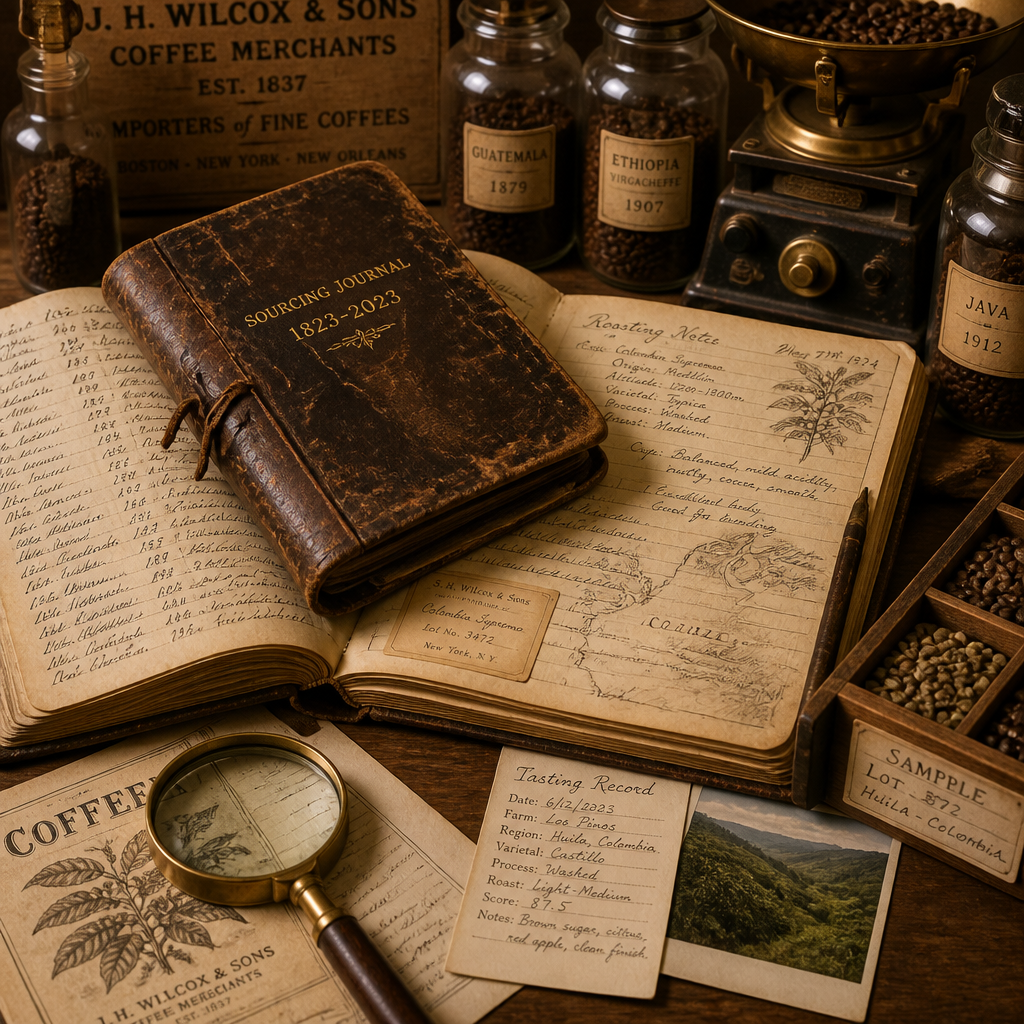
Farrer's was established in 1819 on Stricklandgate in Kendal, a market town that sat on major trading routes into the north of England. From the start, the business dealt in imported goods that required reliable, long-distance supplier relationships. Coffee, at the time, was expensive and logistically complex. Building trust with producers was not a values statement. It was simply how you stayed in business.
That foundation has not been abandoned. Farrer's today works with trusted partners and long-term producers who share its values on quality and ethics, selecting coffees and teas that support more sustainable, transparent supply chains wherever possible. The phrase "wherever possible" is honest and important. Ethical sourcing in coffee is not a binary condition. It is a direction of travel, and the businesses making genuine progress are the ones willing to say where they are still working on it.
What Long-Term Relationships Actually Deliver
A buying relationship that spans multiple harvests gives a roaster something no certification body can provide: direct knowledge of how a farm operates year to year. When prices dip on global commodity markets, a roaster with a long relationship and a principled buying policy does not simply switch to a cheaper supplier. That stability matters enormously to producers planning investments in their land and processing equipment.
For Farrer's, this translates into blend consistency that newer brands are still building towards. The house blends that have been part of the Kendal roastery for generations are not just flavour formulas. They are the product of sourcing relationships that have been refined, not reinvented, over time. When you buy a Farrer's blend, you are buying the accumulated knowledge of over two centuries of careful selection.
Pro tip: If you run a cafe or hospitality business and are evaluating a specialty coffee supplier, ask specifically how long they have been buying from their key producers. Longevity of relationship is a far more reliable proxy for ethical sourcing than any single certification sticker.
Understanding the Certifications: Fairtrade, Rainforest Alliance, and Direct Trade
Certification labels are useful because they set independently verified floors for producer treatment, but they are widely misunderstood. Knowing what each one actually guarantees helps you read a coffee bag far more accurately.
Fairtrade
Fairtrade certification is one of the most recognised ethical labels in the world. Its core function is economic: it requires buyers to pay a minimum floor price for certified coffee, protecting farmers if global market prices fall below the cost of sustainable production. It also attaches a Fairtrade Premium, an additional sum paid to cooperatives that can be spent on community infrastructure, equipment, or producer welfare. For smallholder cooperatives in particular, this premium can fund things a fluctuating market price never would.
The limitation of Fairtrade is that the floor price, while protective, can lag behind genuinely premium specialty pricing. A farm producing exceptional quality coffee may earn more under a well-structured direct trade agreement than under Fairtrade alone. The two are not mutually exclusive, but neither is either one sufficient by itself.
Rainforest Alliance
Rainforest Alliance certification focuses primarily on environmental sustainability and biodiversity protection. Certified farms must meet standards covering deforestation prevention, ecosystem conservation, and social responsibility, with the expectation that performance improves year on year. The environmental focus makes it particularly relevant for coffees grown in ecologically sensitive regions.
One important distinction: Rainforest Alliance does not guarantee a minimum price to producers. It is an environmental and social standard, not a pricing mechanism. A roaster can buy Rainforest Alliance certified coffee at market rate while still undervaluing the producer. Certification is a useful signal, but it is not the whole story of an ethical supply chain.
Direct Trade
Direct trade is not a formal certification. It is a sourcing philosophy, and its value varies enormously depending on who is applying it. At its best, direct trade means a roaster buys directly from a farm or cooperative, paying a negotiated price that reflects the coffee's quality, without a commodity market intermediary setting the ceiling. The roaster visits the farm, understands the processing, and builds a relationship based on mutual benefit rather than just price.
At its worst, "direct trade" is a branding term applied to a conventional supply chain with one fewer middleman. The difference is transparency. A roaster genuinely operating on direct trade principles will be able to tell you the name of the farm, the price paid above the C market, and the specific region and harvest year of what you are drinking.
Comparison of Ethical Sourcing Models
| Sourcing Model | What It Guarantees | Key Limitation |
|---|---|---|
| Fairtrade Certification | Minimum floor price for producers; community premium paid to cooperatives; independently audited by Fairtrade International or Fairtrade USA | Minimum price may fall below genuine specialty market value; cooperative model does not always reach individual smallholders directly |
| Rainforest Alliance Certification | Environmental and social standards verified on-farm; focus on biodiversity, deforestation prevention, and worker welfare | No minimum price guarantee; certification threshold allows product with a relatively low percentage of certified content in some categories |
| Long-Term Direct Relationship (Farrer's model) | Negotiated prices reflecting actual quality; supplier loyalty across harvests; transparency on origin and producer; ethical values shared by both parties | Relies on the roaster's own integrity and buying practices rather than third-party audit; requires active relationship management over time |
The table above is not an argument that certifications are worthless. They provide real, auditable benchmarks and they matter particularly in commodity-scale purchasing where personal relationships are impossible. The point is that for a specialty roaster operating with a carefully selected range, the quality of the relationship with producers is a stronger indicator of ethical sourcing than any label applied after the fact.
From Origin to Kendal: The Specialty Coffee Supply Chain
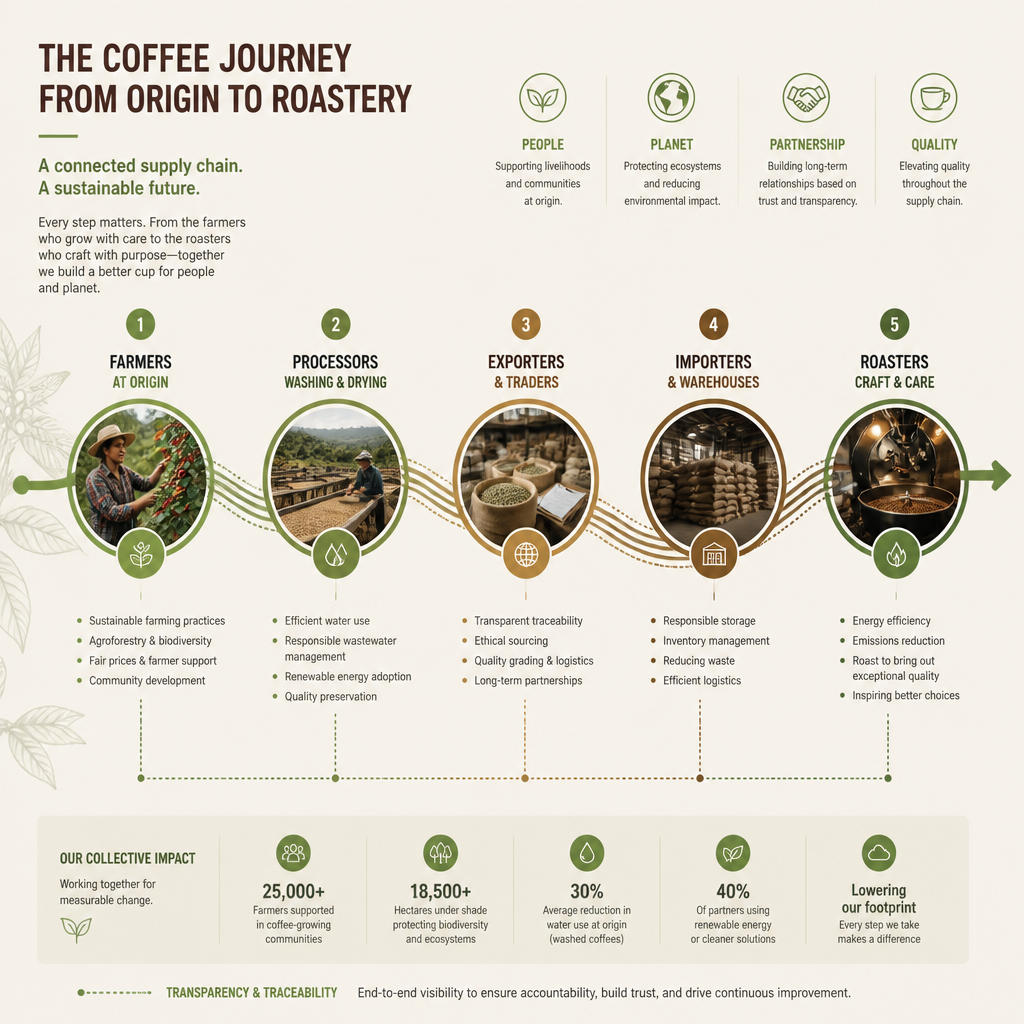
Understanding how coffee moves from a farm to your cup matters if you want to evaluate a roaster's ethical claims honestly. The journey is long and involves multiple stages, each of which represents a point where value can be added or extracted unfairly.
The Stages Between Farm and Roastery
At farm level, coffee cherries are picked, processed, and dried. Processing method, whether washed, natural, or honey, affects both flavour and the resources required. After drying, green coffee is milled, graded, and prepared for export. An exporter or cooperative then handles logistics, customs, and international freight. The green coffee arrives at a UK port before being transported to the roastery.
At each of these stages, price is negotiated and margin is taken. An ethical supply chain is one where the price paid at farm gate reflects the quality and effort of the producer rather than simply the lowest number a buyer can negotiate. Farrer's commitment to working with partners who share its values on ethics means this question of fair farm-gate pricing is built into its selection criteria, not added as an afterthought.
Why Small-Batch Roasting and Traceability Connect
Farrer's roasts in considered batches at its Lake District roastery. This is not just a quality control decision, though it is that too. Small-batch roasting is structurally compatible with traceable sourcing because it demands specificity. When you roast large anonymous volumes, origin information becomes irrelevant. When you roast carefully by batch, knowing exactly where each lot came from is operationally necessary.
Beans are packed quickly after roasting in Kendal so that the flavour in the cup is as fresh as the day it left the roastery. That freshness is only meaningful if the origin quality was worth preserving in the first place, which brings sourcing and roasting ethics into direct alignment.
Ethical sourcing and exceptional flavour are not competing priorities. They are the same priority expressed at different points in the supply chain. The farms that produce the most interesting, complex coffee are almost always the ones that have been treated as long-term partners rather than interchangeable suppliers.
What Sustainable Roasting Actually Looks Like
Sustainability in roasting is often framed purely in environmental terms, which is too narrow. A genuinely sustainable roasting operation is one that can maintain its quality, supplier relationships, and values over decades, not just one that has switched to recyclable packaging.
Farrer's has been doing exactly this for over 200 years. The fact that original recipes have been handed down through generations and refined but not abandoned is evidence of a particular kind of operational discipline. Recipes are only worth preserving if the sourcing behind them is consistent. You cannot hand down a blend if you source it differently every year.
The Role of Single Origins in an Ethical Range
Single-origin coffees are a direct expression of sourcing ethics because they name their geography explicitly. A single-origin bag commits the roaster to a specific farm, cooperative, or region, making vague claims about ethical sourcing impossible to sustain. If the coffee is from a named producer, buyers can research that producer, and the roaster is accountable.
Farrer's range includes single-origin coffees alongside its established house blends, reflecting the expanded sourcing work and transparency that has developed alongside its two-century heritage. This is the right move for any roaster serious about both quality and accountability.
Barista Training as a Sourcing Education Tool
Farrer's barista training programmes and roastery experience days serve a function that goes beyond technical skill development. They are, in practice, a way of transmitting sourcing knowledge down the supply chain to the people actually making drinks for customers. A barista who understands where a coffee comes from and why it tastes the way it does is a far more effective advocate for ethical sourcing than any packaging copy.
For trade customers, this is a genuine advantage. The ability to tell a supplier's sourcing story fluently at the point of sale builds customer loyalty in a way that a generic "ethically sourced" sticker never will.
Pro tip: If you are a cafe or restaurant owner looking to build a credible sustainability story around your coffee offer, start with roastery training. Understanding the sourcing context firsthand gives you specific, honest talking points that customers trust far more than boilerplate claims.
How to Shop Ethically as a Home Enthusiast or Trade Buyer
Ethical shopping in coffee is not complicated, but it does require moving past the label and asking better questions. Here is a practical framework for both home buyers and trade buyers.
For Home Enthusiasts
Start by choosing a roaster whose sourcing story you can actually read and verify. Farrer's publishes its values clearly: trusted partners, shared ethics, transparent supply chains. That is a starting point you can hold a supplier to. From there, explore the range. Single-origin coffees from Farrer's coffee selection tell you something specific about where your money is going. Blends that have been refined over generations tell you something about the long-term quality of the sourcing relationship behind them.
A Farrer's coffee subscription is a practical way to maintain consistent ethical purchasing without having to make active decisions every month. Your chosen blend arrives on a schedule you control, freshly roasted and dispatched from Kendal, with the sourcing values of the UK's oldest coffee roaster behind every bag.
For Trade Buyers: Cafes, Restaurants, and Hospitality
Trade buyers carry a particular responsibility because their purchasing decisions scale up. A cafe buying from an ethically sourced roaster multiplies that sourcing choice across every cup it serves. When evaluating a sustainable coffee roaster as a trade supplier, the questions to ask are specific: How long have you been buying from your key producers? Can you name the cooperatives or farms behind your core espresso blend? What happens to your buying relationship with a producer when market prices fall?
Farrer's trade supply offer is backed by over 200 years of buying and roasting expertise from the Kendal roastery. The coffees are roasted to perform through milk, the teas are carefully balanced for consistent service, and the sourcing behind both reflects relationships built on shared values rather than price-driven switching. That is the kind of supplier story a good hospitality business can build on.
Frequently Asked Questions
What does ethical coffee sourcing actually mean for a UK roaster?
It means choosing suppliers based on shared values around fair pricing, transparency, and producer welfare, not just the cheapest available green coffee. For a UK roaster like Farrer's, it means working with long-term partners whose practices you understand and whose livelihoods your buying decisions directly support. It is reflected in how much information a roaster is willing to share about where its coffee comes from and at what price.
Is Fairtrade certification the best indicator of ethical coffee?
Fairtrade is a strong and independently audited baseline, particularly for cooperatives of smallholder farmers. It guarantees a minimum price floor and a community premium. However, it is not the only indicator, and it is not always the ceiling. Many specialty roasters build relationships that result in farm-gate prices well above Fairtrade minimums through direct negotiation. The best approach is to look at both the certifications a roaster holds and the sourcing relationships it maintains.
How is Farrer's approach to sourcing different from a mass-market roaster?
The fundamental difference is the selection criteria. Farrer's sources from trusted partners who share its values on quality and ethics, prioritising sustainable, transparent supply chains. A mass-market roaster operating at commodity scale is typically optimising for price consistency and volume, not for producer relationships or origin traceability. Small-batch roasting in Kendal and a carefully curated range are structural commitments to quality-led sourcing that mass-market operations cannot replicate.
What is the Farrer's coffee supply chain transparency story?
Farrer's carefully sources its coffees and teas from trusted partners around the world, then roasts them in considered batches at its Lake District roastery to bring out the character of each origin. Beans are packed quickly after roasting so freshness is preserved from Kendal to the customer's cup. The roastery experience days and barista training programmes extend that transparency further, giving trade customers and enthusiasts direct insight into the sourcing and roasting philosophy.
Does buying from an ethical coffee roaster actually cost more?
Not always, and not in the way people assume. Buying from a roaster with strong sourcing values often delivers better consistency, better flavour, and a more defensible story for your menu or home brewing. The price premium, where it exists, reflects the real cost of paying producers fairly and roasting with care. For trade buyers, the value of a supplier with a credible ethical story goes well beyond the per-kilo price, particularly as customer awareness of sourcing practices continues to grow.
Can I visit Farrer's to learn more about how they source and roast their coffee?
Yes. Farrer's offers roastery experience days at its Kendal roastery in the Lake District. These are an opportunity to understand the sourcing philosophy, the roasting process, and the values behind the range firsthand. For trade buyers in particular, a roastery visit is the most effective way to understand the supplier story well enough to communicate it to your own customers with confidence.
If you have bought from Farrer's, or if you are actively thinking about what ethical sourcing means for the coffee you buy or serve, share your experience below. Hearing from home enthusiasts and trade buyers alike helps build a more honest conversation about what good sourcing actually looks like in practice.
References
- Farrer's values, sourcing philosophy, and roastery heritage as published on the Farrer's official website
- Farrer's 200-year history as the UK's oldest coffee roaster, covering Kendal origins and the evolution of sourcing and blending practice
- An independent overview of ethical coffee sourcing approaches including Fairtrade, Rainforest Alliance, and direct trade models
- A detailed explainer on how UK specialty roasters approach ethical sourcing beyond standard certifications


