

Most coffee drinkers have no idea how old the coffee in their supermarket bag actually is. By the time commercial coffee reaches a shelf, it may have been roasted weeks or even months earlier, its most volatile aromatics already long gone. Small-batch coffee roasting exists as a direct answer to that problem. It is not a marketing label. It is a fundamentally different approach to heat, timing, and volume, one that produces a measurably more complex, vivid, and fresh cup. At Farrer's, roasting in small batches has been the standard for over two centuries, not because it is fashionable, but because it is the only way to do the job properly.
Table of Contents
- Quick Takeaways
- What Small-Batch Roasting Actually Means
- The Science of Flavour Development
- Freshness and Why It Changes Everything
- Roast Profiles and Origin Respect
- Small-Batch vs. Commercial Roasting: A Direct Comparison
- What This Means for Your Cup at Home
- Frequently Asked Questions
- References
Quick Takeaways
| Key Insight | Explanation |
|---|---|
| Smaller drum size means better heat control | Artisan roasters typically use drums holding 5 to 30 kg per batch, allowing precise temperature management that large industrial machines cannot replicate. |
| The Maillard reaction is the engine of flavour | This chemical process, where amino acids and sugars react under heat, creates the complex flavour compounds in coffee. Small-batch roasting lets the roaster control it precisely. |
| Freshly roasted coffee degasses actively | After roasting, beans release CO2 over days. Coffee brewed during this window extracts more evenly and tastes more vibrant than stale, over-degassed coffee. |
| Every origin needs its own roast profile | A floral Ethiopian and a heavy Sumatran cannot share the same roast curve. Small-batch roasting makes individual profiling practical. Commercial roasting does not. |
| Commercial roasters sacrifice nuance for volume | Industrial drums holding hundreds of kilograms use generic, preset profiles. This flattens the distinctive characteristics that make a single-origin coffee worth drinking. |
| Roast-to-order means peak flavour at delivery | When a roastery dispatches coffee within days of roasting, you receive it inside its optimal flavour window, not months into its decline. |
| Batch size affects quality traceability | Small batches make it easier to trace a flavour fault back to its source and correct it, keeping quality consistent across every order. |
What Small-Batch Roasting Actually Means
The term gets used loosely, so it is worth being precise. Small-batch roasting refers to roasting coffee in limited quantities rather than large industrial-scale production runs. In practice, artisan roasters work with drums that typically hold between 5 and 30 kilograms of green coffee per cycle. Large commercial operations run machines that can process hundreds of kilograms in a single pass. That volume difference is not just logistical. It is the root cause of almost every quality distinction between artisan and mass-market coffee.
When a drum is smaller, heat transfers more evenly and consistently across every bean in the batch. The roaster can monitor colour, smell, and sound in real time, making adjustments that would be impossible to implement meaningfully at industrial scale. This hands-on control is not a romantic notion. It is the practical mechanism through which better flavour is achieved.
At a roastery like Farrer's, which has been operating in the Lake District for over 200 years, small-batch roasting is not a recent pivot toward craft. It is the original method, maintained precisely because the quality argument has never changed. The beans are hand-packed and roasted in quantities that keep every batch traceable, adjustable, and fresh.
The Science of Flavour Development
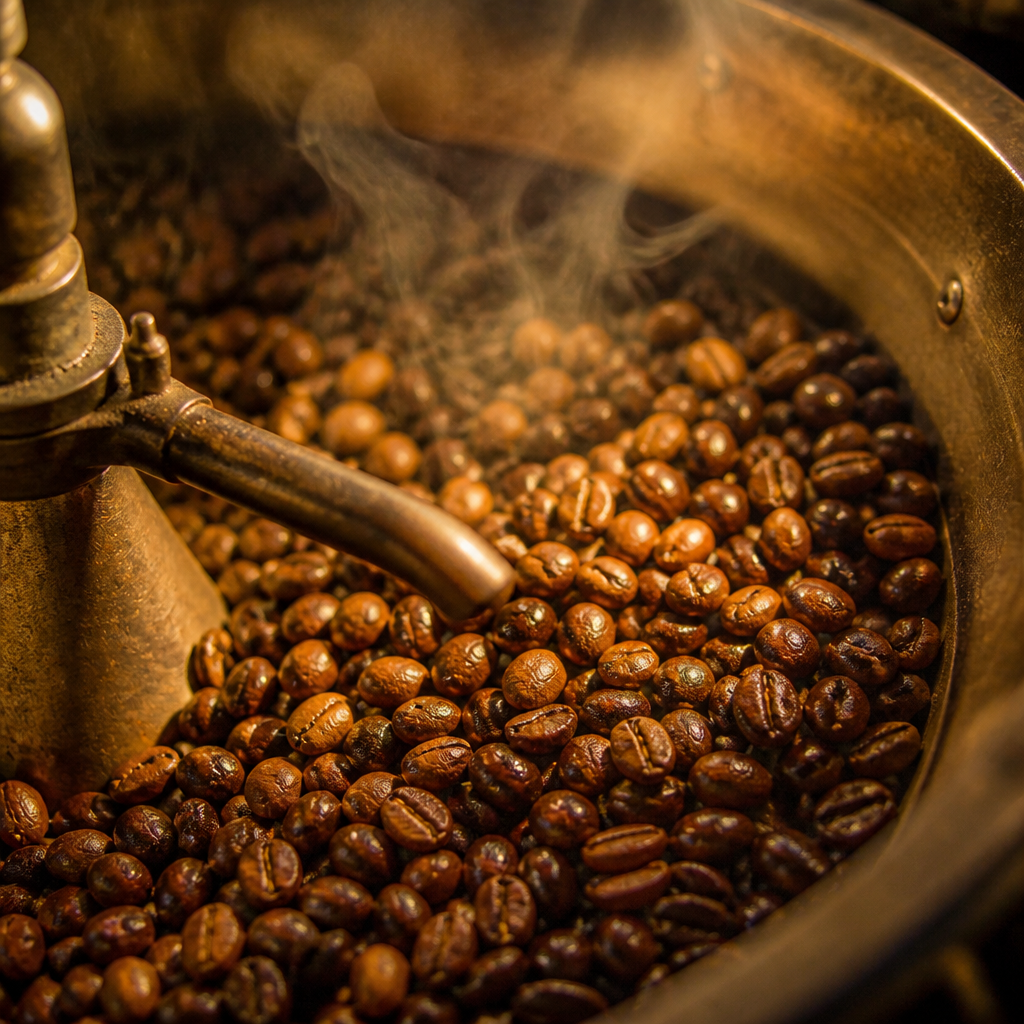
Understanding why small-batch roasting produces better flavour requires a short detour into the chemistry of roasting. Green coffee beans contain hundreds of flavour precursors, compounds that only become recognisable flavours once they are exposed to the right amount of heat for the right amount of time. The process that matters most is the Maillard reaction, the chemical interaction between amino acids and sugars that produces the browning of the bean and the development of complex flavour compounds.
Why Maillard Control Requires Precision
The Maillard reaction is not a single event. It unfolds in stages across a temperature range, and what happens at each stage shapes the final cup. Push through too fast and you develop harsh, underdeveloped notes. Linger too long past the optimal window and the flavours become flat or burnt. In a small-batch roast, the roaster can closely monitor the colour change and aroma as the beans progress, adjusting heat application to hit the precise curve that unlocks a specific bean's best qualities.
In an industrial roaster processing a very large volume, heat distribution becomes uneven. Beans near the drum wall behave differently from those in the centre. The system compensates with preset, automated profiles that average across the whole batch, trading precision for repeatability at scale. The result is a cup that tastes consistent but flat.
The Role of First Crack and Development Time
Experienced roasters also listen for audible cues during the roast. First crack, an exothermic event where built-up steam and CO2 fracture the bean's cell structure, signals the entry into the development phase. The time between first crack and the end of the roast, often called the Development Time Ratio, determines how much of the Maillard flavour chemistry is completed. Too short and the coffee tastes underbaked. Too long and bitterness dominates. A small-batch roaster adjusting in real time can hit this window consistently for a given bean. An automated commercial system cannot do the same for every bean type it processes.
Pro tip: When you buy freshly roasted coffee, check whether the roaster publishes specific roast profiles or flavour notes by origin. A roastery that describes an Ethiopian differently from a Colombian is one that is actually dialling in individual profiles, not running everything through a single preset.
Freshness and Why It Changes Everything
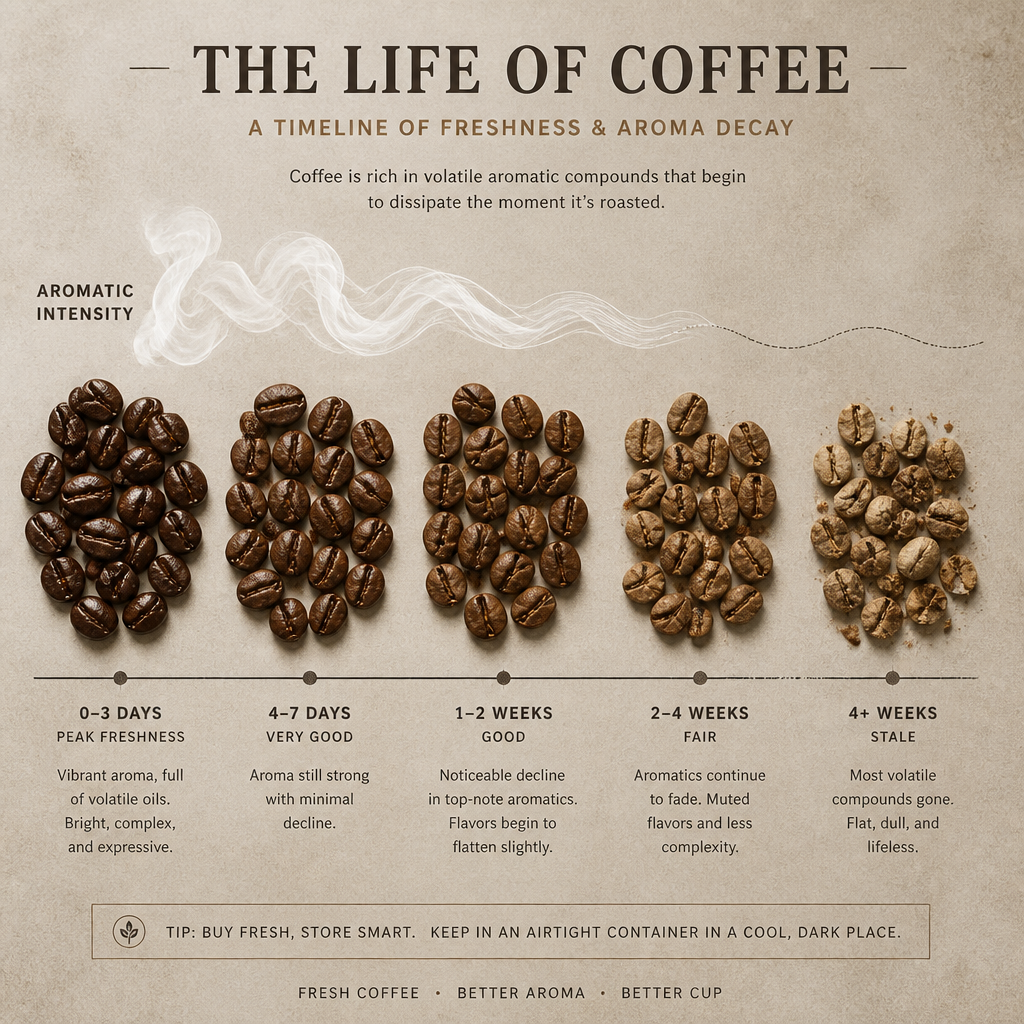
Roasting transforms green coffee into something chemically active. Immediately after the drum stops, the beans begin releasing carbon dioxide, a process called degassing. This is not a flaw. It is evidence that the coffee is genuinely fresh. The aromatics that make a well-roasted coffee rewarding, the fruit esters, the floral compounds, the caramel volatiles, are released alongside that CO2 over the days and weeks following roasting. Leave the coffee long enough and those compounds dissipate into the air, leaving behind a flat, papery impression of what the coffee once was.
Commercial roasters roast enormous quantities in advance to supply large distribution networks. By the time that coffee reaches a retailer, is shelved, and is purchased, it may be months past its roast date. Small-batch roasters, particularly those operating a roast-to-order model, send coffee out within days of roasting. You receive it inside its optimal window, not on the tail end of it.
Coffee brewed within a reasonable window after roasting will taste better regardless of storage method. The aromatics that define its character are volatile and they leave over time. Freshness is not a bonus, it is the prerequisite for everything else.
This is a structural advantage that large roasters cannot easily replicate. Their business model depends on producing at scale and distributing across wide geographies and retail networks. Freshness, at that model, is secondary to logistics. At Farrer's, next-day dispatch on orders over £35 exists precisely to close the gap between roast date and your kettle.
Pro tip: Always check for a roast date on the bag, not just a best-before date. A best-before date tells you when the coffee becomes undrinkable. A roast date tells you when it was at its best, which is the information that actually matters for dialling in your brew.
Roast Profiles and Origin Respect
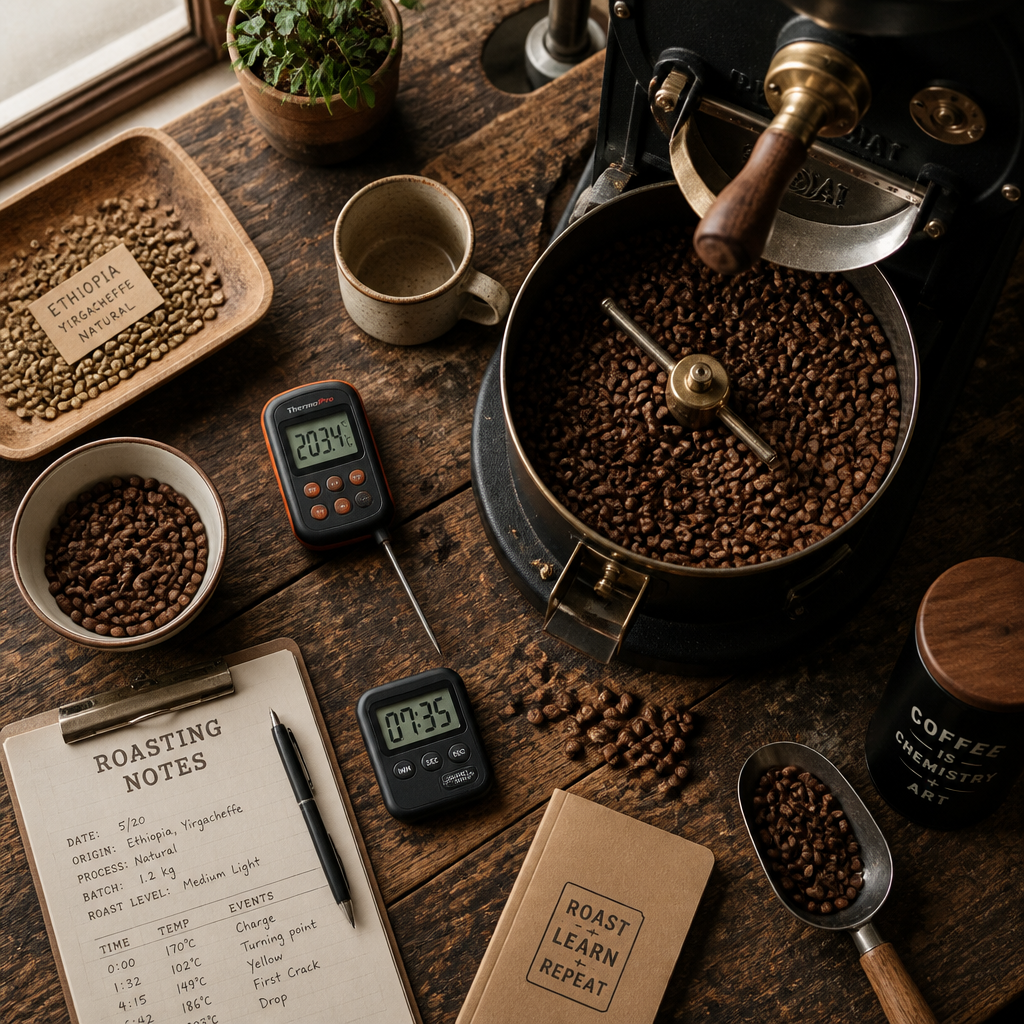
Single-origin coffee is only worth the premium if the roaster treats it as a distinct raw material rather than an interchangeable commodity. A bright, floral Ethiopian Yirgacheffe and a deep, earthy Sumatran Mandheling are not simply different in taste. They are different in moisture content, bean density, and sugar composition. They require entirely different approaches to temperature curve, development time, and charge temperature. Applying a single generic roast profile to both produces a result that is neither one thing nor the other.
Why One-Size-Fits-All Roasting Fails Single Origins
Large commercial roasters often operate with standardised roast profiles designed to produce reliable output across high-volume, mixed-origin blends. For their core product, this works well enough. But it makes genuine single-origin expression impossible, because the precision required to highlight the floral notes of a washed Ethiopian or the stone-fruit character of a natural Kenyan is simply not achievable when you are running hundreds of kilograms through the same temperature programme.
Small-batch roasting makes individual profiling practical. When each batch is small enough for one roaster to monitor continuously, they can build and refine a bespoke curve for each green coffee. The result is a cup that genuinely reflects where the bean came from and how it was grown, not a cup that tastes like the roaster's default output.
Blends Benefit Too
The same principle applies to blends. A well-constructed blend does not just throw multiple origins into the same roast. The best approach involves roasting each component to its own ideal profile and combining them afterward, a method only practical at small-batch scale. This preserves the contribution of each origin rather than compromising all of them to suit a shared roast curve. Farrer's coffee blends, developed over generations of roasting experience, reflect exactly this level of intentional construction.
Small-Batch vs. Commercial Roasting: A Direct Comparison
The differences between artisan small-batch roasting and large-scale commercial roasting are not marginal. They compound at every stage of the process, from batch size through to what lands in your cup. The table below maps the key distinctions directly.
| Factor | Small-Batch Artisan Roasting (e.g. Farrer's) | Large-Scale Commercial Roasting |
|---|---|---|
| Batch size | Typically 5 to 30 kg per cycle, allowing close monitoring | Industrial drums can hold 200 kg or more per cycle |
| Heat control | Roaster adjusts temperature curves in real time based on bean behaviour | Automated presets designed for consistency across large volumes |
| Roast profile per origin | Each origin receives a bespoke profile tailored to its density and sugar content | Generic profiles applied across mixed origins; individual expression is flattened |
| Time from roast to dispatch | Often roasted to order, dispatched within days | Roasted in advance for distribution networks; shelf time extends weeks or months |
| Flavour outcome | Greater clarity, pronounced origin character, more complex aromatic profile | Reliable consistency, but flatter, less distinct flavour |
| Traceability and quality correction | Faults identified and corrected batch by batch | Harder to isolate and correct issues across large runs |
The comparison above is not an argument that commercial coffee is undrinkable. It is an argument that the ceiling for flavour quality is structurally lower when roasting at scale. If you are spending money on good coffee, the roasting process is where that investment either pays off or gets squandered.
What This Means for Your Cup at Home
The practical implication is simple: the best brewing equipment in the world cannot rescue coffee that was roasted three months ago in a 500 kg drum and left to sit in a warehouse. The quality in the cup is built at the roastery, not at the kitchen worktop. This is why the decision of which roaster you buy from matters more than many home brewers appreciate.
When you order from an artisan roaster like Farrer's, you are not just buying beans with a nicer bag. You are buying a cup that received individual attention at the most critical stage of its journey. The roaster watched those specific beans move through the Maillard reaction. They listened for first crack. They pulled the batch at the right moment for that particular origin. Every variable that determines flavour was managed by a person who cares about the outcome.
The difference is noticeable. Not in a vague, theoretical way. In the cup, on the first sip, when the aromatics are still vivid and the flavour develops across the palate rather than landing flat. That is what freshly roasted coffee from a genuine artisan coffee roaster in the UK actually tastes like, and once you have experienced it, supermarket coffee feels like a different drink entirely.
If you are exploring Farrer's range, consider starting with a single-origin coffee before moving to blends. A single origin makes the roaster's craft most visible, because there is nowhere for an imprecise roast to hide. If the floral notes are there, if the brightness is clean, if the finish is long, the roasting was done properly. If it tastes muddy or flat, it was not.
Frequently Asked Questions
What is considered small-batch coffee roasting?
Small-batch coffee roasting refers to roasting coffee in limited quantities, typically between 5 and 30 kilograms per cycle, rather than running industrial-scale drums holding hundreds of kilograms. The defining characteristic is not a specific weight limit but the level of hands-on control the roaster can exercise over heat, timing, and bean development throughout the process.
Does freshly roasted coffee really taste noticeably better?
Yes, and the difference is not subtle once you have experienced it side by side. Freshly roasted coffee retains its volatile aromatic compounds, the fruit esters, floral notes, and caramel volatiles that define its character. These compounds dissipate over time. Coffee that is weeks or months past its roast date loses this complexity and tastes flat, papery, or generically bitter. Roasting to order and dispatching quickly is the only way to ensure the coffee arrives in its optimal state.
Why do artisan coffee roasters in the UK charge more than supermarket brands?
The price difference reflects the cost of genuine small-batch production. Roasting in smaller quantities is less efficient per kilogram than industrial roasting. It also requires more skilled labour, more time per batch, and often involves sourcing higher-quality green coffee with more transparent supply chains. What you pay for is not a brand name but measurably better flavour, fresher delivery, and a product that received individual attention at every stage.
How long after roasting should I brew my coffee?
For filter and pour-over brewing, most roasters recommend waiting 5 to 14 days after the roast date before brewing, to allow sufficient degassing without losing too much of the aromatics. For espresso, the optimal window is generally slightly longer, often 10 to 21 days, because the remaining CO2 can cause issues with extraction consistency. Your roaster's specific guidance for each coffee is always the most reliable reference, since roast level and origin affect the degassing rate.
Can I tell if coffee has been roasted in small batches just from the packaging?
The most reliable indicator is a printed roast date, not just a best-before date. A roastery that publishes roast dates is typically producing in small enough quantities to track individual batches. You should also look for specific flavour notes per origin, named sourcing relationships, and a relatively short best-before window from roast date. Generic packaging with no roast date and a long shelf life is a strong signal of commercial-scale roasting.
What is the difference between a roast profile and a roast level?
A roast level, light, medium, or dark, describes the final colour and general flavour direction of the bean. A roast profile is the full temperature and timing curve used to get there, including how quickly the drum is charged, when the Maillard reaction begins, how long development time lasts after first crack, and when the batch is dropped. Two coffees can be the same roast level but have been developed with entirely different profiles. The profile is where the real craft lies, and it is what small-batch roasters tailor to each specific green coffee.
Have you noticed a difference switching from supermarket coffee to freshly roasted small-batch coffee? Share your experience in the comments, we would genuinely like to hear what changed in your cup.
References
- How small-batch roasting delivers superior freshness and flavour complexity in artisan coffee
- The science of the Maillard reaction and flavour control in small-batch coffee roasting
- What micro-batch coffee roasting means for temperature control and flavour development
- Why roasting in small batches improves roast curve tracking and flavour quality
- Why small-batch roasting produces more distinct and origin-true coffee flavours


