

Most people buying coffee online focus on origin, roast level, or price. Very few think about what happens in the minutes between the beans leaving the roaster and landing in the bag. That gap, brief as it sounds, is where a significant amount of flavour is either preserved or lost.
Hand packed coffee UK is a phrase that gets used loosely by brands who want the craft association without doing the actual craft. At Farrer's, roasting and hand packing in Kendal since 1819, it means something specific and verifiable.
This article explains what hand packing actually involves, why packaging method directly affects cup quality, and why the distinction matters far more than most buyers realise.
Table of Contents
- Quick Takeaways
- What Hand Packed Actually Means
- The Science of Freshness After Roasting
- Why Automated Packing Cuts Corners You Cannot See
- The Role of the One-Way Valve
- Farrer's Kendal Roastery: What Hand Packing Looks Like in Practice
- Packaging Method Comparison
- What This Means for Trade Buyers and Cafes
- Frequently Asked Questions
- References
Quick Takeaways
| Key Insight | Explanation |
|---|---|
| Hand packing means individual staff weigh, fill, and seal each bag manually | This is not a cosmetic difference. It reduces dwell time between roasting and sealing, directly preserving CO2 and aromatic compounds in the bean. |
| Coffee begins losing aromatic compounds rapidly in the first three weeks post-roast | The Specialty Coffee Association notes CO2 degassing occurs most rapidly in the first 20 days after roasting. The sooner beans are sealed, the more flavour is locked in. |
| Automated packing lines drift in calibration across production runs | Hand packing allows bag seal integrity and fill consistency to be checked batch by batch, catching problems before they ship. |
| A one-way degassing valve is essential, not optional | It lets CO2 escape without allowing oxygen in. Without it, freshly roasted coffee either bursts the bag or stales rapidly. Farrer's includes this on all roastery bags. |
| Farrer's has hand packed coffee in Kendal continuously since 1819 | That makes it the UK's oldest operating coffee roastery. The method is not a trend adoption. It is the founding practice, maintained because it works. |
| "Hand packed" is not a protected term in UK food labelling | Any brand can use it. Verified hand packing means asking whether individual staff physically fill and seal each bag, or whether an automated line does the work and a human only loads it. |
| Next-day dispatch compounds the freshness advantage | Farrer's dispatches orders over £35 the next working day. A bag hand packed on Monday and brewed on Wednesday is a genuinely different product from one warehoused for weeks after machine filling. |
What Hand Packed Actually Means
The term is applied by brands with a wide range of actual practices behind it. In the most minimal interpretation, a product is described as hand packed because a person lifted a pre-filled container into a box. That is not what the term should mean, and it is not what it means at Farrer's.
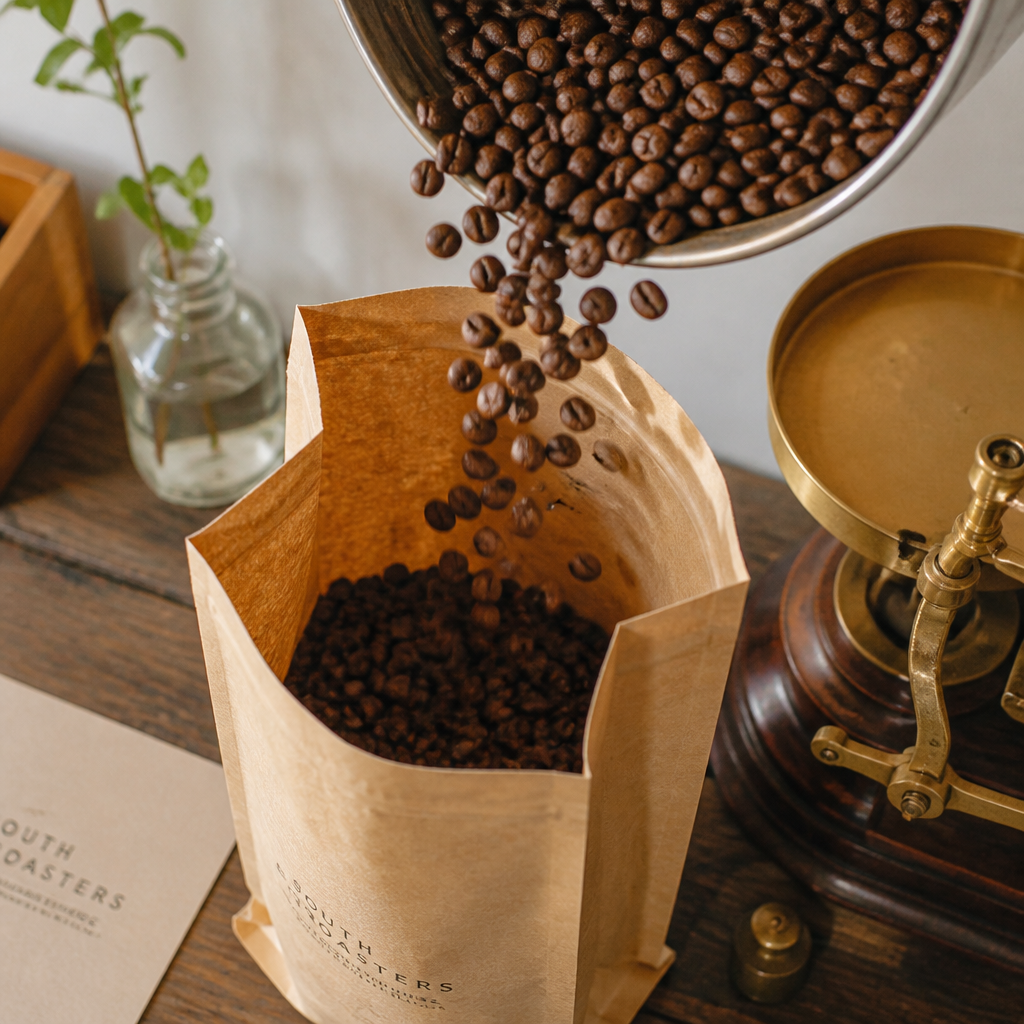
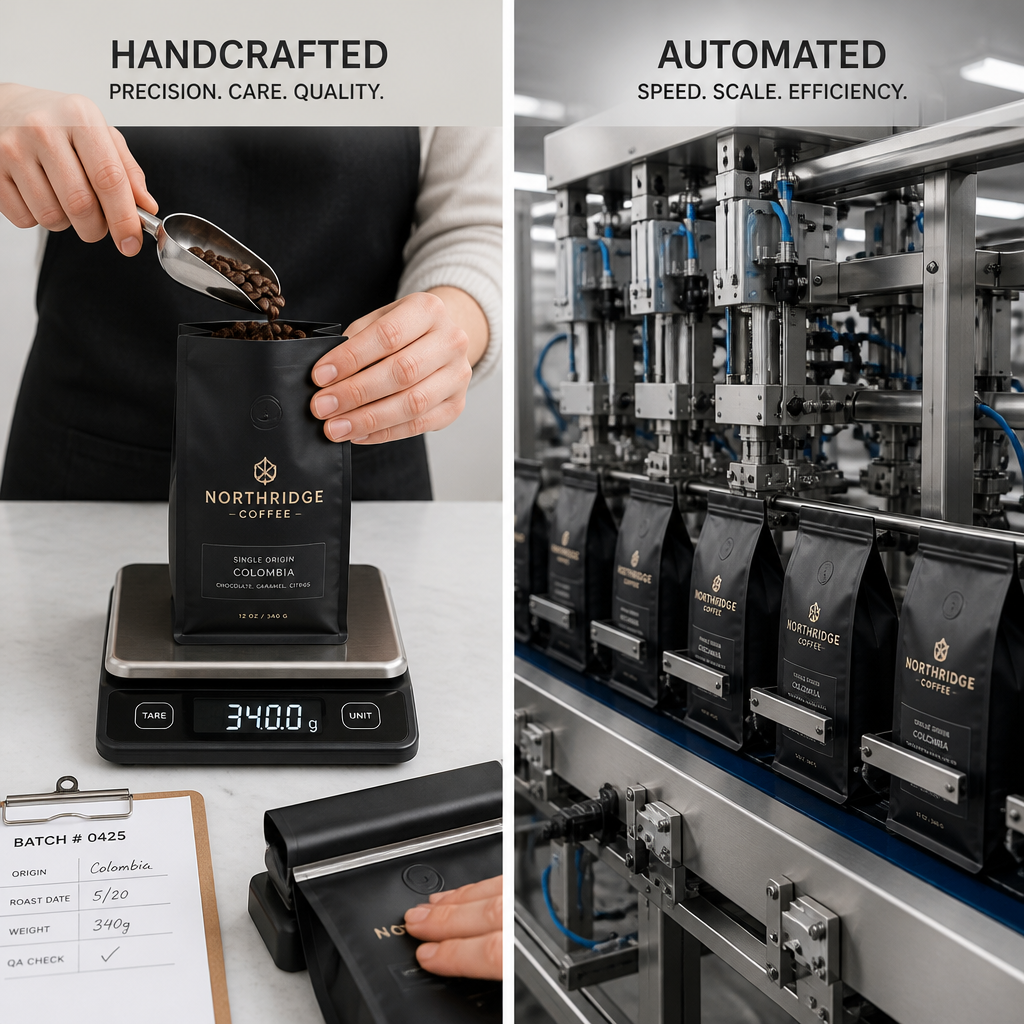
At Farrer's Kendal roastery, hand packed means individual staff members physically weigh, fill, and seal each bag after beans have cooled on the cooling tray following roasting. There is no automated volumetric filling line involved. The process is slower and more labour-intensive by design.
The practical consequence of this approach is that dwell time between roasting completion and bag sealing is reduced compared to batching beans for machine processing. Every additional minute a freshly roasted bean sits exposed before sealing is a minute of CO2 and aromatic compound loss. Speed to seal is not a minor operational detail. It is a direct flavour variable.
The Science of Freshness After Roasting
Roasting transforms green beans through a series of chemical reactions that create the aromatic compounds responsible for coffee's flavour and smell. Those compounds begin dissipating the moment roasting ends. This is not a slow, gentle process.
The Specialty Coffee Association has documented that CO2 degassing occurs most rapidly in the first 20 days after roasting, slowing dramatically afterwards. During that same window, coffee is losing its volatile aromatic compounds at the highest rate. The fresher the seal, the more of that complexity survives to the cup.
The carbon dioxide in roasted coffee beans forms a barrier against oxidation, part of the staling process that degrades quality by altering the bean's essential oils and aromatic components. Limiting storage time after roasting is one of the most effective ways to preserve cup quality.
Oxidation is the main enemy after roasting. Oxygen attacks the lipids and volatile aromatics in the bean, producing stale, flat, or rancid flavours. Any packaging method that delays sealing, allows air ingress, or lacks a proper one-way valve is allowing oxidation to begin before the bag reaches the customer.
Why the window between roasting and sealing is the critical variable
In practice, the difference between a bag sealed within minutes of cooling and one that sat in a hopper for two hours before machine filling is real and detectable. Home brewers with a calibrated palate notice it as reduced brightness and shorter finish. Espresso machines surface it even more clearly: less CO2 in the bean means a weaker crema and a flatter extraction.
For cafes and hospitality businesses relying on consistent shot quality, this is not an abstract concern. It is the difference between a table of customers ordering a second coffee and one round being enough.
Pro tip: If you are ordering coffee for a cafe or restaurant, ask your supplier how long beans typically sit between roasting and dispatch. A hand packed, next-day dispatch operation like Farrer's gives you a verifiable freshness window. A supplier who cannot answer that question probably cannot guarantee it either.
Why Automated Packing Cuts Corners You Cannot See
Automated volumetric filling lines are efficient and cost-effective at scale. They are also imprecise in ways that matter for premium coffee. Calibration drifts over a production run. Fill weights vary. Seal integrity is checked statistically, not individually. A certain percentage of under-sealed or overfilled bags is accepted as within-tolerance loss.
That tolerance is invisible to the customer receiving the bag. But it shows up in flavour. An imperfect seal allows air ingress over the weeks between packing and use. A slightly overfilled bag compresses beans in ways that can affect grind consistency.
Quality control as a structural argument for hand packing
Every bag that passes through human hands is a bag that can be checked for roast consistency, bean integrity, and correct grind level. That check happens at Farrer's before the bag is sealed, not after a statistical sample fails downstream. Automated packing at scale does not allow for that kind of individual verification.
For customers, hand packing means that when something is wrong, it is caught before it ships. Farrer's 4.9 out of 5 verified customer rating reflects that reliability as much as it reflects the roast quality itself. Consistent delivery of a consistent product is not possible without consistent process control, and hand packing is where that control is applied.
A common mistake buyers make is assuming that a higher price from a large roaster with slick branding reflects a more careful process. In practice, premium pricing at volume brands often reflects marketing spend and packaging design rather than production method. The roasting may be excellent and the beans well-sourced, but the packing line is the same one running at commercial scale with the same tolerance losses built in.
The Role of the One-Way Valve
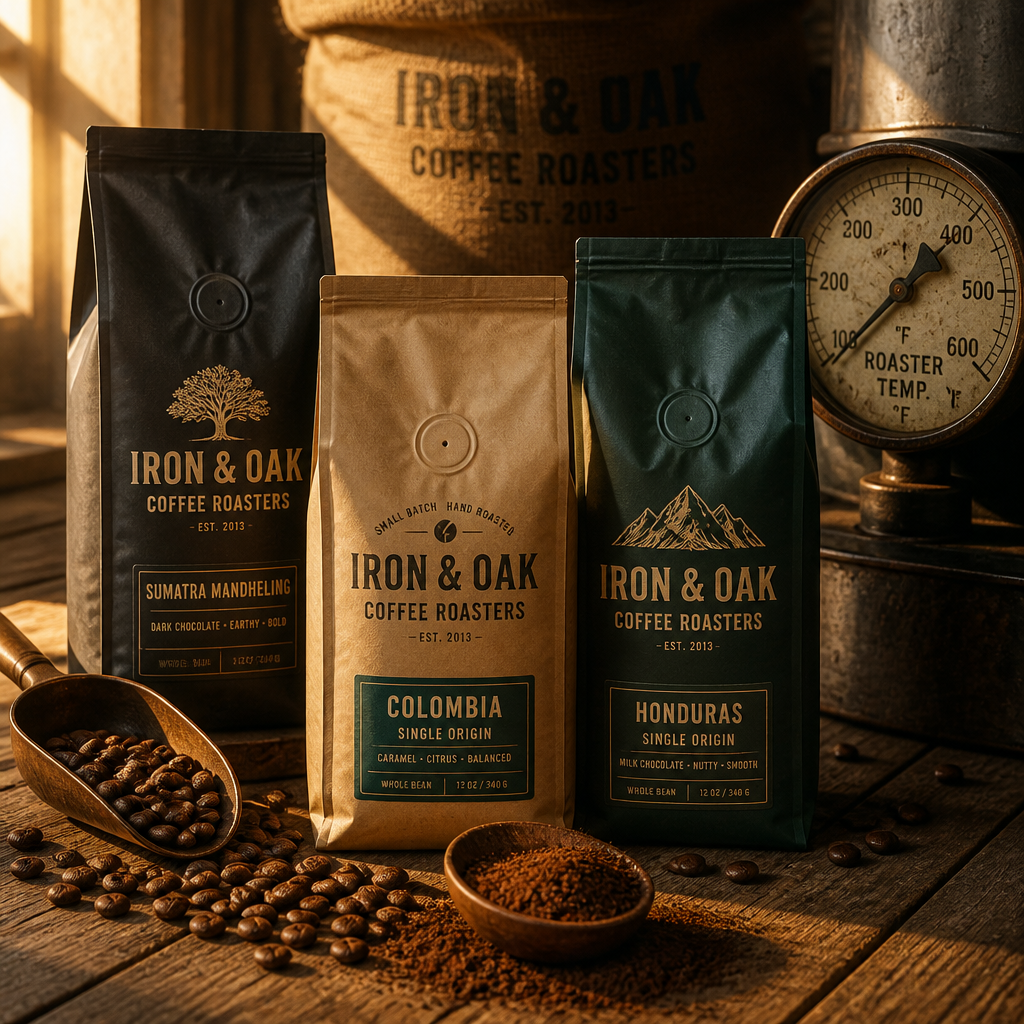
A one-way degassing valve on a coffee bag is not a premium feature or a design choice. It is a functional necessity for any bag containing freshly roasted coffee. Freshly roasted beans release significant CO2 for several days after roasting, sometimes up to ten days depending on roast level and bean density. Without a valve, that gas has nowhere to go and the bag either bloats and fails, or the roaster pre-degasses the beans before packing, which means deliberately letting aromatic compounds escape before sealing.
The valve allows CO2 to exit while blocking oxygen from entering. That one-directional function is what makes it possible to seal a bag within minutes of roasting without the bag rupturing, and without the contents staling from oxygen exposure.
What happens when coffee is packed without a valve
Pre-degassing is standard practice for vacuum-packed ground coffee sold in brick format at supermarkets. The coffee is roasted, allowed to degas until most CO2 has dissipated, and then vacuum sealed. The result is a shelf-stable product that photographs well and has a long use-by date. It also has already completed the most dynamic phase of post-roast flavour evolution before you open the bag. What you are buying is a preserved version of what the coffee was, not the coffee at its best.
Farrer's bags include a one-way CO2 degassing valve. This is not incidental. It is the mechanism that makes genuine freshness delivery possible. Without it, hand packing speed would be irrelevant because there would be no way to seal the bag promptly without compromising it.
Pro tip: When a bag of coffee you have just opened does not bloom when you pour hot water over it in a cafetiere or pour-over, the CO2 has already left. That bloom is not aesthetic. It is the gas that was still in the bean at brewing time, which means the bean was fresh enough to retain it. No bloom, no freshness signal.
Farrer's Kendal Roastery: What Hand Packing Looks Like in Practice
Farrer's was established in Kendal in 1819 and has operated continuously since, making it the UK's oldest active coffee roastery. The founding location was on Stricklandgate in Kendal, where roasting happened on site and customers could observe the process directly. That transparency was not a marketing strategy. It was simply how a small roaster operated when everything was visible and proximate.
The address has changed over the roastery's history but the production philosophy has not. Farrer's still roasts in small batches and still hand packs every bag, operating from the heart of the Lake District. The Lake District's exceptionally soft water profile has also influenced how Farrer's roasters calibrate their blends over generations, a regional advantage that compounds the quality argument beyond packaging alone.
Roastery experience days and what they reveal about the process
Farrer's offers roastery experience days, which give trade buyers and home enthusiasts direct access to the roasting process. Seeing the journey from green bean intake to cooling tray to hand-packed valve bag removes the abstraction from the quality argument entirely. It is considerably harder to accept a stale supermarket bag as adequate once you have watched freshly roasted beans go directly into hand-packed packaging within minutes of cooling.
This transparency is not available from competitors who pack at volume facilities remote from their roasting sites, or who contract packing out to third parties. Farrer's from bean to bag roastery process is a single integrated chain in Kendal. Every stage is owned and controlled by the same team.
Packaging Method Comparison
Not all coffee packaging methods are equal, and the differences have real consequences for what ends up in the cup. The table below compares the three most common approaches found across the UK specialty and mainstream coffee market.
| Packaging Method | Freshness Outcome | Quality Control Level |
|---|---|---|
| Hand packed with one-way valve (Farrer's approach) | Maximum. Beans sealed within minutes of cooling, CO2 preserved, oxidation minimised. One-way valve allows continued degassing without air ingress. | Individual bag check at point of filling. Roast consistency, bean integrity, and seal quality verified per bag before dispatch. |
| Automated filling line with degassing valve | Good if dispatch is prompt. Machine calibration drift means some bags are slightly under or overfilled. Statistical seal checking means a proportion may have imperfect seals. | Sample-based rather than individual. Problems are caught after the fact in aggregate rather than at the bag level. |
| Vacuum brick pack (pre-degassed ground coffee) | Poor for peak flavour. Coffee is deliberately degassed before sealing, meaning the most volatile aromatic compounds have already dissipated before the bag is closed. | Consistent fill and seal integrity. Quality control applies to the process but the product has already passed peak freshness before packaging begins. |
What This Means for Trade Buyers and Cafes
For a home buyer ordering a bag of coffee for weekend brewing, freshness is a matter of personal enjoyment. For a cafe or restaurant, it is a commercial variable with direct consequences for consistency and customer perception. A shot that pulls flat because the beans were stale going into the hopper is a shot you cannot charge premium prices for, regardless of the menu description.
Farrer's serves cafes, restaurants, and hospitality businesses with professional-grade supplies and next-day dispatch on orders over £35. That dispatch speed is not just a logistics feature. It is the final link in the freshness chain. A bag hand packed in Kendal on a Tuesday morning and brewed in a Lake District hotel on Wednesday is a genuinely different proposition from a bag that was machine-packed three weeks ago and has been sitting in a distributor's warehouse.
Barista training alongside fresh supply
Farrer's also offers barista training programmes, which gives trade buyers something competitors cannot easily replicate: the ability to understand the relationship between fresh packaging, correct storage, and extraction quality in a single integrated programme. There is little benefit in sourcing freshly hand packed coffee and then storing it incorrectly on site, or grinding it at the wrong coarseness for the equipment being used.
The combination of hand packed freshness, next-day dispatch, and on-site training creates a supply relationship that supports consistent quality at the point of service, which is ultimately the only measure that matters in a hospitality context.
Pro tip: If you run a cafe and are comparing coffee suppliers, request a sample specifically as a blind extraction test rather than a dry aroma assessment. Freshness differences that are subtle in the bag become obvious in the cup, particularly in espresso where stale beans produce flat shots with thin crema regardless of the machine settings you use.
Frequently Asked Questions
What does hand packed coffee actually mean?
Hand packed coffee means individual members of staff physically weigh, fill, and seal each bag rather than a machine doing so through an automated volumetric filling line. The key distinction is that every bag receives individual attention, which allows for quality checks at the point of filling rather than statistical checks after the fact. At Farrer's, hand packing happens after beans cool from the roaster, minimising the time between roasting and sealing.
Does the way coffee is packed really affect how it tastes?
Yes, directly. The time between roasting completion and bag sealing determines how much CO2 and aromatic compounds are preserved in the bean. The sooner a bag is sealed with a proper one-way valve after roasting, the more flavour survives to your cup. Packaging method also determines whether oxidation begins before or after you open the bag. A well-sealed, freshly hand packed bag with a degassing valve keeps oxygen out until you open it. A poorly sealed or pre-degassed bag is already staling from the moment it leaves the production line.
Why does Farrer's describe itself as the UK's oldest coffee roaster?
Farrer's was established in Kendal in 1819 and has operated continuously since, making it the oldest active coffee roastery in the UK by a significant margin. That founding date precedes virtually every brand currently visible in the UK specialty market. The Kendal roastery has maintained its core practices of small-batch roasting and hand packing throughout that period, which is documented in the company's own history and independently verifiable.
Is hand packed coffee more expensive, and is the premium justified?
Hand packing is more labour-intensive than automated filling, which does carry a cost. Whether the premium is justified depends entirely on what you are comparing it against. If the alternative is a vacuum-packed supermarket bag that was pre-degassed before sealing and has been on a shelf for weeks, the freshness difference is substantial enough to justify a price difference. If you are comparing against another hand packed, promptly dispatched specialty roaster, the comparison shifts to roast quality and sourcing. Farrer's is competitive on all three variables, which is why its verified customer rating sits at 4.9 out of 5.
How should I store hand packed coffee once I open the bag?
Once opened, the original bag becomes less effective because the seal at the top is compromised. Use the original bag for the first few days after opening, keeping it folded tightly shut. After that, transfer to an airtight canister kept away from heat, light, and moisture. A glass jar with a genuinely airtight lid and rubber seal works well in a dark cupboard. Avoid leaving coffee on a kitchen worktop or near a window, where light and temperature fluctuation accelerate staling. If you order trade or bulk quantities, only open what you need for the current week and keep the rest sealed.
How does Farrer's compare to other UK specialty roasters on packaging?
The primary difference between Farrer's and larger volume specialty brands is the combination of hand packing and next-day dispatch from a single integrated roastery. Some competitors roast well but contract packing or warehousing to third parties, which introduces delay and removes direct oversight of seal quality. Others pack on automated lines with degassing valves, which is functional but lacks individual bag verification. Farrer's hand packing in Kendal means the same team that roasts the coffee seals the bag, and that bag dispatches the next working day. That chain of custody matters for freshness in a way that branding alone cannot replicate.
Can I visit Farrer's roastery in Kendal to see the hand packing process?
Yes. Farrer's offers roastery experience days that give visitors direct access to the full production process, from green bean intake through roasting to hand packing. These are available to both home buyers and trade customers. Seeing the process in person is the most direct way to understand the quality argument, and it is considerably harder to tolerate inferior packaged coffee after watching freshly roasted beans go straight into hand-packed valve bags on site.
If you have ordered hand packed coffee from Farrer's, visited the Kendal roastery, or switched from a volume brand and noticed a freshness difference in the cup, share what you found in the comments. Your experience is exactly what other buyers, home enthusiasts, and cafe owners need to hear when making sourcing decisions.
We would love your feedback and any insights you would share with others. What perspective would you add?
References
- Inside Farrer's Kendal roastery: the hand packing and small-batch roasting process explained
- Farrer's 200-year story: how the UK's oldest coffee roaster has maintained hand packing and quality standards
- Why the Lake District produces world-class roasters: small-batch methods and hand packing in Cumbria
- Specialty Coffee Association: the science of freshness, CO2 degassing, and flavour preservation after roasting
- How one-way degassing valves work and why they are essential for freshly roasted coffee packaging


