

Most people ordering coffee online think the roast profile is what separates a great cup from a mediocre one. They are wrong. Roast quality sets the ceiling, but freshness determines how close you actually get to it.
Fresh coffee delivery UK customers receive from a roaster that dispatches the same or next day is measurably different in the cup from coffee that spent three weeks in a distribution warehouse before it reached a shelf.
Farrer's has been roasting in Kendal, in the Lake District, for over 200 years, and the operational decision to offer next-day dispatch on orders over £35 is not a marketing add-on. It is the whole point.
Table of Contents
- Quick Takeaways
- Why Freshness is Chemistry, Not Marketing
- What Next-Day Dispatch Actually Means in Practice
- Hand Packing and the Role of Degassing Valves
- Comparing Dispatch Models: Roaster Direct vs Retail vs Subscription
- Who Benefits Most From Next-Day Coffee Dispatch
- How to Get the Most From Farrer's Delivery
- Frequently Asked Questions
- References
Quick Takeaways
| Key Insight | Explanation |
|---|---|
| Freshness is measurable, not subjective | Coffee loses its most volatile aromatic compounds within hours of roasting. The first two weeks represent peak flavour development. |
| Next-day dispatch preserves the peak window | Farrer's dispatches orders over £35 next day, meaning UK customers receive coffee genuinely within its optimal flavour window. |
| CO2 degassing matters for extraction | Freshly roasted beans release CO2 for 24 to 72 hours post-roast. One-way degassing valves let gas escape without allowing oxygen in. |
| Hand packing reduces dwell time | Individual staff weigh, fill, and seal each bag, cutting the time between roasting and sealing and preserving aromatic compounds. |
| Retail coffee is almost always stale | A bag on a supermarket shelf may have been roasted months earlier. After 30 days in a non-valve bag, degradation is detectable even to an untrained palate. |
| The roast date is the signal to look for | A roaster who takes freshness seriously will always display the roast date, because it is a genuine competitive advantage, not something to hide. |
| Trade customers need consistency, not just quality | Cafes and hospitality businesses relying on Farrer's next-day dispatch can plan stock without holding large quantities of ageing coffee. |
Why Freshness is Chemistry, Not Marketing
The word "fresh" gets used so carelessly in food marketing that most consumers have learned to ignore it. With coffee, that scepticism has a real cost, because freshness is not a lifestyle claim. It is a chemical fact with a measurable timeline.
Roasting transforms green beans through a series of reactions that produce hundreds of aromatic and flavour compounds. The moment roasting ends, those compounds begin to degrade. Carbon dioxide, produced in abundance during roasting, starts escaping the bean structure. Oxygen starts its work on the oils and aromatics. The result is that a beautifully sourced Ethiopian Yirgacheffe roasted eight months ago will taste flat, papery, and thin compared to a well-sourced Colombian roasted two weeks ago, even if the Ethiopian bean was technically superior at the point of roasting.
The research on this is not contested. The optimal window for most coffees is between 7 and 30 days post-roast, depending on the origin and roast profile. Most coffee reaches its peak flavour window about 3 to 14 days after roasting, with whole bean coffee staying fresher longer than ground coffee because less surface area is exposed to oxygen. The practical upshot is that dispatch speed is not a convenience feature. It is the mechanism by which you access or miss that window entirely.
Freshness is not a marketing claim. It is chemistry. Coffee begins losing its most volatile aromatic compounds within hours of roasting, and the first two weeks represent peak flavour development with CO2 off-gassing creating the conditions for proper extraction.
After 30 days in an unsealed or non-valve bag, the degradation is measurable even to an untrained palate. Most retail coffee never comes close to the peak window, because the logistics of manufacturing, boxing, shipping to a warehouse, and distributing to shelves take weeks by design. This is why the dispatch speed of a coffee delivery service matters as much as the quality of the roast itself.
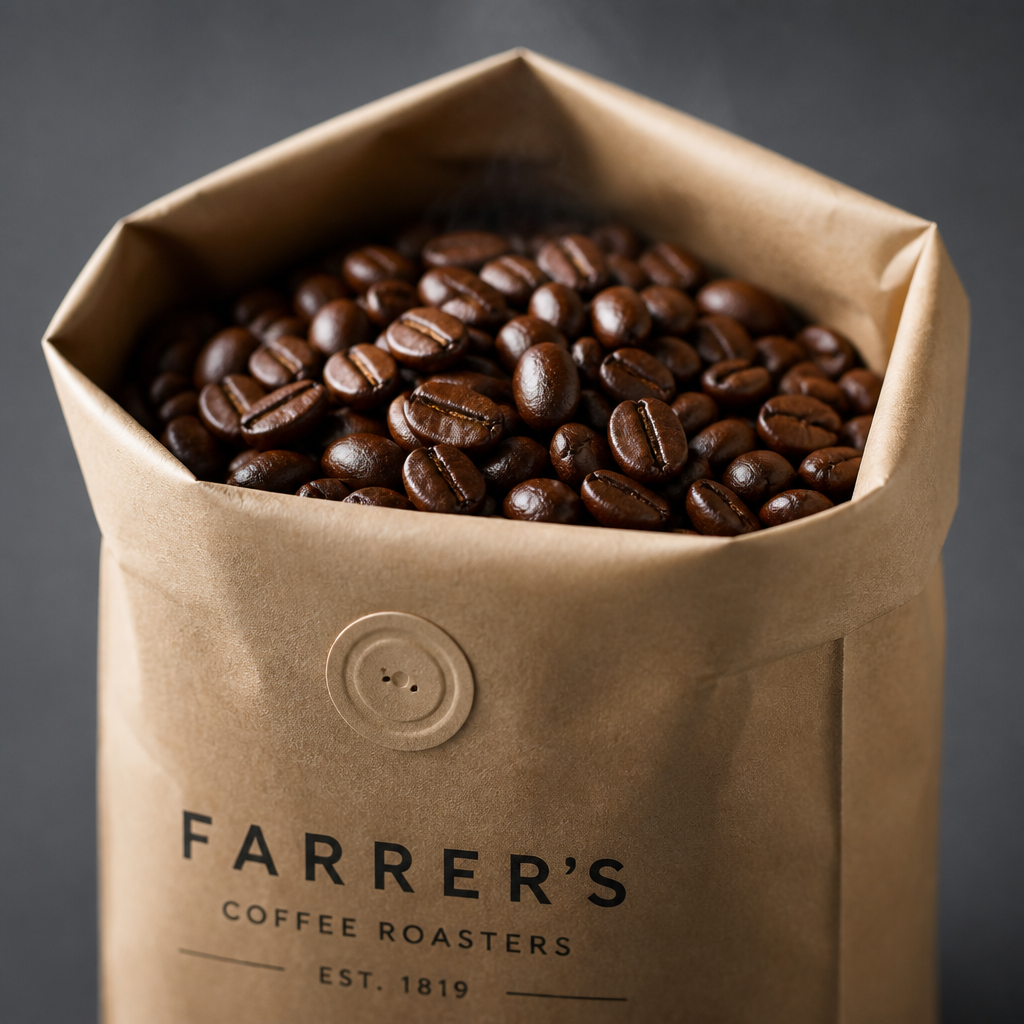
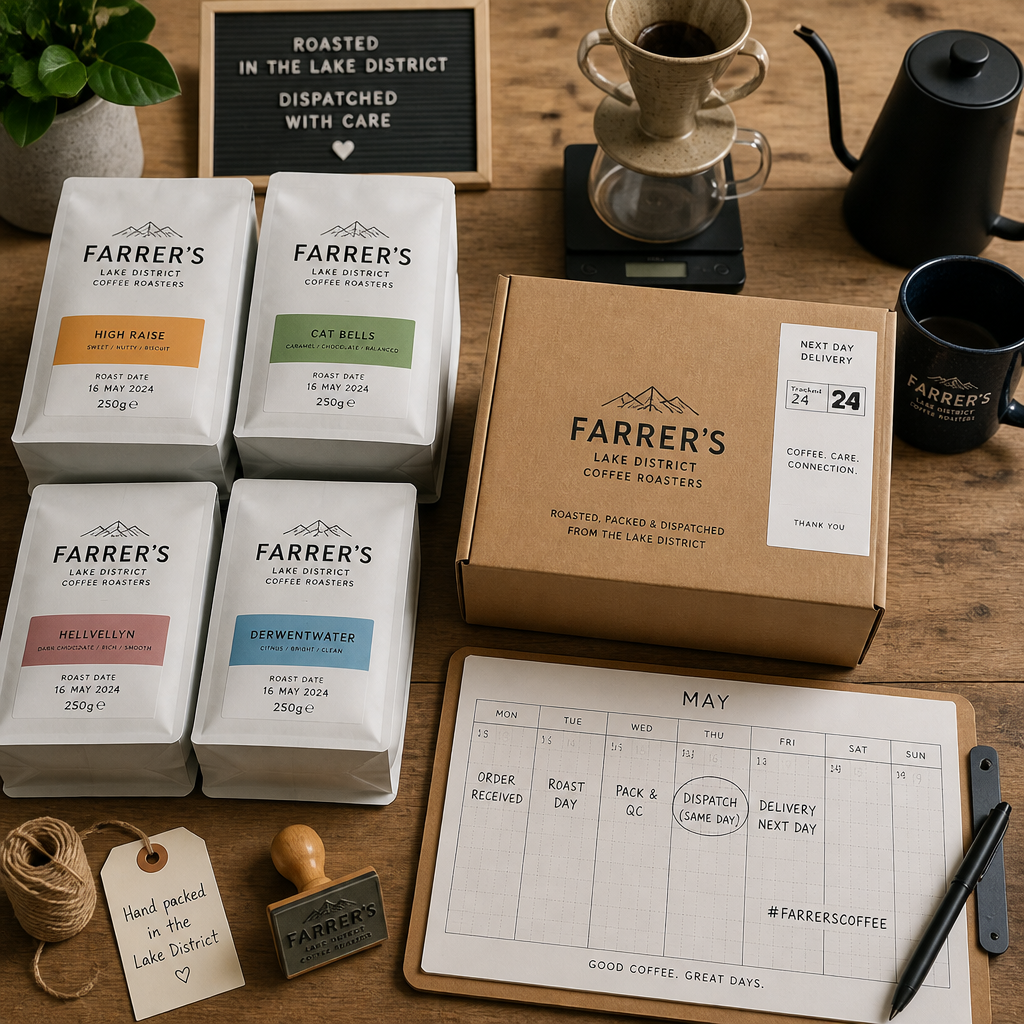
What Next-Day Dispatch Actually Means in Practice
A next-day dispatch promise sounds simple. In practice, it requires a roasting and packing operation that is tightly coordinated rather than batch-oriented. Farrer's operates out of Kendal, at the southern gateway to the Lake District, and next-day dispatch on orders over £35 is not a headline offer bolted onto a marketing page. It is the operational backbone of how freshly roasted coffee reaches customers while it still has flavour.
For the home buyer, this means that if you order on a Monday, you are likely drinking coffee that was roasted within the previous few days by Tuesday. That is a genuinely different experience from opening a bag that was roasted four months before you bought it from a supermarket shelf.
What trade customers gain from this model
For cafes, restaurants, and hospitality businesses, the advantage compounds. Stock management becomes simpler when you can rely on next-day delivery for orders over a set threshold. You do not need to hold three months of stock in a back room, where even the best-packaged coffee slowly ages. You can order more frequently in smaller volumes and serve coffee that is consistently within its peak window.
Farrer's trade account customers can access professional-grade supplies with this same dispatch commitment, which means a busy cafe in the north of England can maintain freshness without the complexity of holding buffer stock to cover unreliable lead times.
Pro tip: If you are running a cafe or small hospitality business, calculate your weekly coffee usage and order just above the £35 threshold on a set day each week. You get next-day dispatch without tying up cash in large orders that sit and age.
Why geography helps here
Kendal sits at the southern gateway to the Lake District, and that geography is not a marketing detail. Ambient conditions inside a roastery directly affect the post-roast stabilisation of coffee, and the relatively cool, low-pollution air of Cumbria reduces the oxidative stress on freshly roasted beans compared to an urban roastery in, say, London or Manchester. For UK delivery specifically, this position means the distance from roast to doorstep stays short for the vast majority of customers.
Hand Packing and the Role of Degassing Valves
The mechanics of how Farrer's packs its coffee matter more than they might seem. Hand packing means individual staff members weigh, fill, and seal each bag rather than an automated volumetric line doing so. The practical benefit is reduced dwell time between roasting and sealing, which preserves CO2 and aromatic compounds.
This is not a nostalgic preference for craft over efficiency. It is a functional choice. Large automated lines are designed for scale and throughput, not for minimising the gap between roast and seal. When that gap is reduced, more of the volatile aromatics that make freshly roasted coffee worth buying are still in the bag when it reaches you.
The degassing valve: why it is not optional on fresh coffee
The degassing valve is critical: freshly roasted coffee continues releasing CO2 for 24 to 72 hours post-roast. A valve lets that gas escape without allowing oxygen in, which is why fresh beans in a properly valved bag stay viable for significantly longer than beans in a sealed bag without one. Freshly roasted coffee beans enter a 24 to 72 hour degassing period immediately after roasting, during which they release carbon dioxide produced during the roasting process. Coffee experts recommend waiting until this degassing completes before brewing, as the CO2 can interfere with proper water extraction.
A common mistake consumers make is assuming any sealed bag means fresh coffee. Without a one-way valve, a roaster must wait until enough CO2 has off-gassed before sealing, which adds days between roasting and packaging. With a valve, the bag can be sealed immediately, preserving more of what makes fresh coffee taste fresh.
Pro tip: When your Farrer's order arrives, store whole beans in the original sealed bag with the valve intact, away from direct light and heat. Resist the temptation to decant into a glass jar immediately. The bag was designed to protect what is inside it.
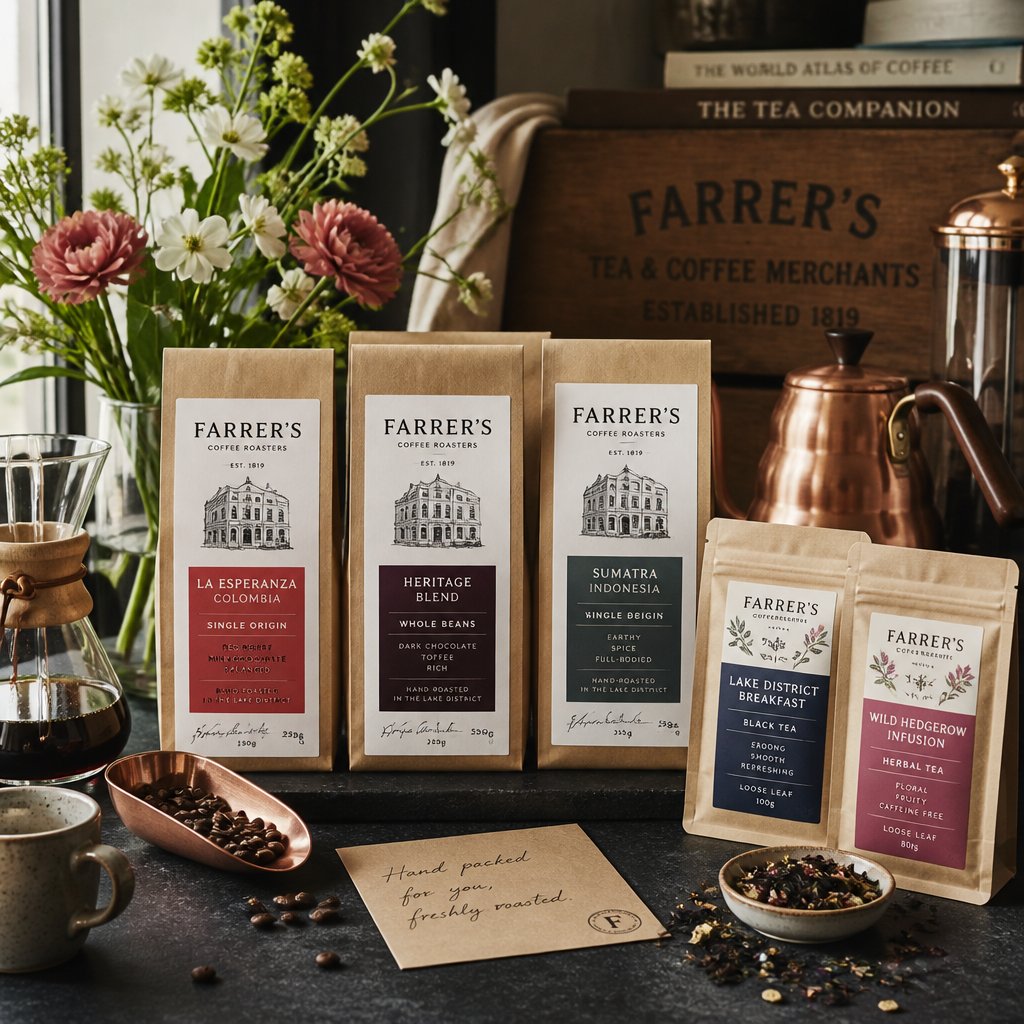
Comparing Dispatch Models: Roaster Direct vs Retail vs Subscription
Not all coffee delivery is equal, and the differences go well beyond price. The table below outlines how three common buying models compare on freshness, convenience, and control.
| Buying Model | Typical Time from Roast to Doorstep | Best For |
|---|---|---|
| Roaster Direct (e.g. Farrer's online shop with next-day dispatch) | 2 to 5 days post-roast for most UK addresses | Home enthusiasts who want genuine freshness on demand, with flexibility to try different blends each order |
| Supermarket or retail shelf | Often 4 to 12 months post-roast, with no roast date visible on many bags | Convenience purchasing where freshness is not a priority |
| Coffee subscription (roaster-dispatched) | Same as roaster direct but automated. Farrer's dispatches subscriptions on the same next-day model for orders over £35 | Regular home drinkers and trade buyers who want a set-and-forget supply of fresh coffee without reordering manually each time |
A roaster dispatching next day on orders over £35, as Farrer's does, ensures that the coffee arriving in your letterbox or on your doorstep is genuinely within its peak window. The retail model cannot offer this, because the economics of shelf retail require long shelf lives and centralized distribution that inherently adds weeks or months of age to the product before it reaches a consumer.
The subscription model is worth noting separately. A roastery roasts and ships coffee fresh to order rather than fulfilling it from pre-roasted stock held in a warehouse, which means the subscription model and the roaster-direct model deliver the same freshness guarantee when the roaster operates on a next-day dispatch basis. For high-volume home drinkers or trade buyers, this makes subscriptions the most efficient way to maintain a consistent supply of genuinely fresh coffee.
Who Benefits Most From Next-Day Coffee Dispatch
The honest answer is: anyone who can taste the difference between fresh and stale coffee, which is most people who take the time to brew carefully. But some buyers benefit more than others.
Home enthusiasts with specific brewing methods
Espresso and filter brewing are both affected by bean freshness, but in slightly different ways. Espresso prepared from very fresh beans can be over-gassy and difficult to dial in during the first few days after roasting, which is why the 7 to 14 day window post-roast is often cited as optimal for espresso. Lighter roasts, due to their denser structure, retain more complex acidity and benefit from a longer rest period. Filter methods tend to be more forgiving of beans that are on day three or four post-roast.
The practical consequence is that next-day dispatch, paired with knowing your roast date, gives you the control to brew at the right point in the degassing cycle rather than guessing.
Cafes and hospitality businesses
A busy cafe serving 200 espressos a day cannot afford the quality variance that comes from using beans at random points in their freshness curve. Consistent dispatch speed means consistent coffee quality in the cup, which matters commercially because customers notice, even if they cannot articulate exactly why one day's flat white tastes better than the last. Farrer's has served both home enthusiasts and trade customers for over 200 years, and the operational infrastructure behind next-day dispatch was built to serve both audiences simultaneously.
Gift buyers who cannot afford to be wrong
Farrer's offers next-day dispatch on orders over £35, which makes it practical for last-minute gifting without sacrificing freshness. Buying coffee as a gift from a supermarket shelf, without knowing the roast date, is a genuine risk. The recipient might receive a bag of coffee roasted six months before it was gifted. Next-day dispatch from a roaster eliminates that risk entirely.
How to Get the Most From Farrer's Delivery
Understanding the freshness window is one thing. Using it well takes a small amount of planning, most of which becomes instinctive after the first few orders.
Order whole beans rather than pre-ground if you have any grinder at home. Whole bean coffee stays fresher longer than ground coffee because less surface area is exposed to oxygen. Even a basic hand grinder will extend the useful life of your bag by several days compared to receiving pre-ground coffee that begins oxidising the moment it is ground.
Check the roast date on your bag when it arrives. Farrer's roast date information gives you a concrete reference point for when your beans are likely to be at their best. If you are brewing espresso, give the beans a few days of rest before pulling your first shot. If you are brewing filter, you can often start earlier.
For trade customers, Farrer's serves both home enthusiasts and trade customers, including cafes, restaurants, and hospitality businesses, with trade accounts able to access professional-grade supplies with next-day dispatch on qualifying orders. Setting up a trade account and establishing a regular order schedule removes the friction of ad-hoc reordering and ensures your stock is always within its freshness window.
Finally, consider the threshold. Next-day dispatch applies to orders over £35. Ordering enough to cross that threshold and staying consistent with your order frequency is the simplest way to keep your coffee supply fresh without thinking about it every week.
Frequently Asked Questions
What does next-day dispatch mean for coffee freshness?
Next-day dispatch means the gap between roasting and your doorstep is minimised to a few days rather than weeks or months. Since coffee's peak flavour window is broadly between 7 and 30 days post-roast, receiving beans within the first few days post-roast means you control when in that window you brew, rather than receiving coffee that has already passed its best.
How does Farrer's freshly roasted coffee differ from supermarket coffee?
The core difference is time. Supermarket coffee may have been roasted months before you buy it, and many bags carry no visible roast date. Farrer's dispatches freshly roasted stock directly from the Kendal roastery, with next-day dispatch on orders over £35, so the coffee you receive is measured in days from roasting rather than months.
Does freshly roasted coffee need to rest before brewing?
Yes, particularly for espresso. Freshly roasted beans continue releasing CO2 for 24 to 72 hours post-roast, and this gas can interfere with extraction. Most coffee reaches its best around 7 to 14 days post-roast for espresso. Filter brewing is more forgiving and can work well from around day three or four. The roast date on your Farrer's bag gives you the reference point to time this accurately.
Is the next-day dispatch threshold the same for trade and home orders?
Farrer's next-day dispatch applies to orders over £35 for both home and trade customers. Trade accounts have access to professional-grade supplies on the same dispatch model, which makes stock planning for cafes and hospitality businesses straightforward. Ordering regularly above the threshold removes the need for large buffer stocks of ageing coffee.
What is the best way to store coffee received via next-day dispatch?
Keep the beans in the original sealed bag with the one-way degassing valve intact. Store the bag in a cool, dark location away from direct sunlight and heat sources. Avoid decanting into a glass jar immediately, as the original bag is designed to manage the ongoing CO2 release while keeping oxygen out. Only grind what you need for each brew to preserve freshness for as long as possible.
Can I rely on Farrer's delivery for a cafe or restaurant?
Yes. Farrer's has over 200 years of experience serving both home and trade customers, and the next-day dispatch model was built to serve both. For a cafe or restaurant, setting up a trade account and ordering on a consistent weekly schedule above the £35 threshold is the most efficient way to maintain a supply of genuinely fresh coffee without holding large quantities of ageing stock.
Why does Farrer's hand-pack its coffee rather than using automated lines?
Hand packing reduces the dwell time between roasting and sealing. Individual staff members weigh, fill, and seal each bag, which means the gap between the beans leaving the roaster and being protected in a sealed, valved bag is shorter than on a high-throughput automated line. That matters because aromatic compounds and CO2 begin escaping immediately after roasting, and every minute between roast and seal is a minute of freshness lost.
Have you noticed a difference in flavour between coffee ordered direct from a roaster with next-day dispatch and coffee bought from a shelf? Share your experience in the comments, your observations help other coffee drinkers make better decisions about where they buy.
References
- Inside Farrer's Kendal roastery: how hand packing and next-day dispatch work together
- Farrer's guide to UK coffee subscriptions and the role of dispatch speed in freshness
- Freshly roasted coffee UK: why roast date and dispatch speed define the cup
- Understanding roast dates and the coffee flavour window: a practical guide
- Coffee bean shelf life and storage: a complete guide to maximum freshness


