

Most people assume a great coffee blend is simply a matter of mixing beans until something tastes right. In practice, it is far closer to recipe development than guesswork, and the gap between a forgettable blend and a truly balanced cup comes down to decisions made well before the first sample is brewed. Coffee blending in the UK has a long tradition, and no one embodies that tradition more completely than Farrer's, operating from the Lake District for over two centuries. Understanding how a blend is actually constructed, from origin selection through cupping and ratio-setting, changes the way you drink coffee entirely.
Table of Contents
- Quick Takeaways
- What Coffee Blending Actually Means
- Selecting Origins: The First Decision
- Pre-Blend vs. Post-Blend Roasting
- Building Balance: Body, Acidity, and Sweetness
- Arabica, Robusta, and What Each Brings
- Blends vs. Single Origins: Which One and When
- How Farrer's Approaches Blending
- Frequently Asked Questions
- References
Quick Takeaways
| Key Insight | Explanation |
|---|---|
| Blending is recipe development | Every component in a blend has a defined role: brightness, body, sweetness, or depth. Nothing is added at random. |
| Post-blending gives more control | Roasting each origin separately before combining lets the roaster tailor the roast curve to each bean's density and moisture. |
| Consistency is the core advantage | A well-constructed blend holds its character across seasons, where a single origin will shift as each new harvest arrives. |
| Espresso demands tighter tolerances | Espresso amplifies every characteristic in a blend. A flaw that is forgivable in a filter cup becomes prominent under nine bars of pressure. |
| Ratios matter as much as origins | Changing a component from 20% to 30% of a blend can fundamentally shift the cup. Small adjustments have large effects. |
| Arabica and Robusta serve different functions | Arabica delivers complexity and brightness. Robusta contributes body, crema, and caffeine. Used well together, they complement rather than compete. |
| Heritage roasters refine over decades | A blend that has been cupped and adjusted across many years carries a depth of iteration that a new formulation simply cannot replicate. |
What Coffee Blending Actually Means
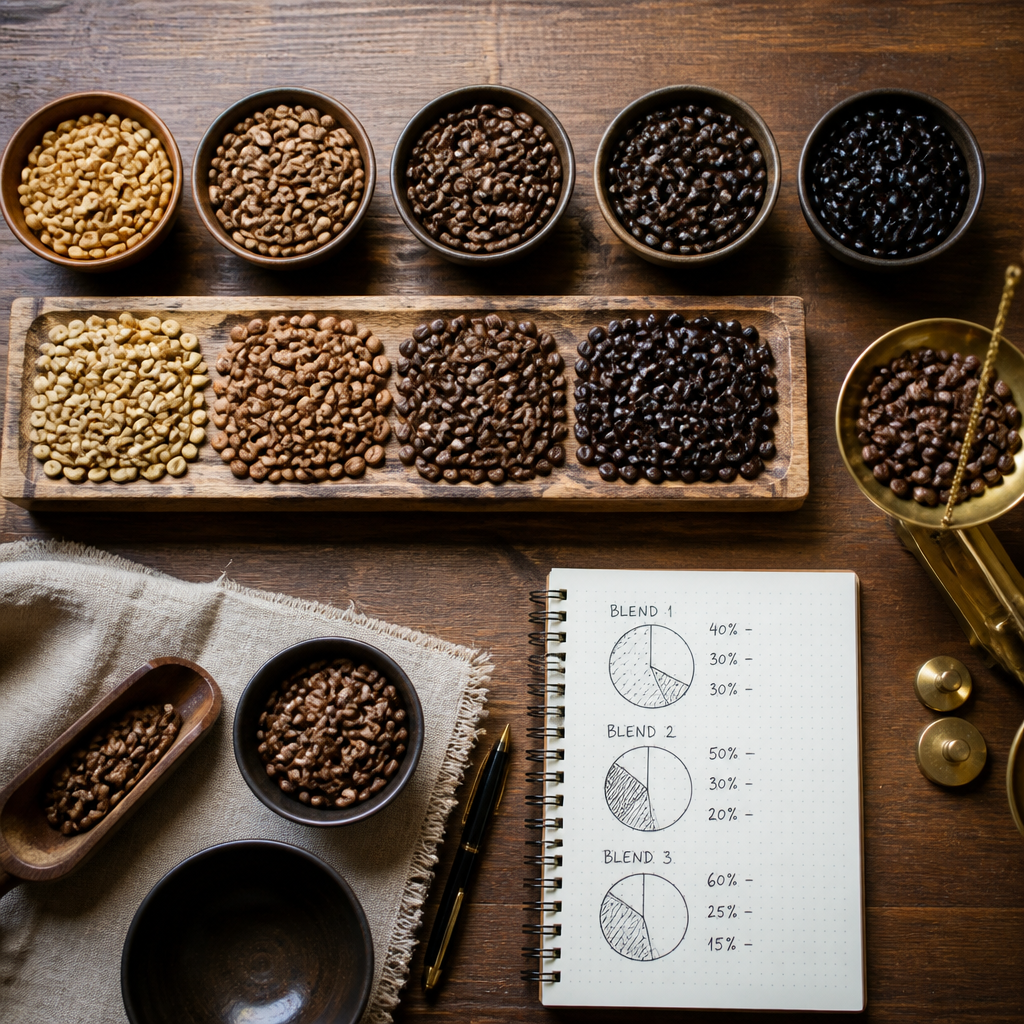
Blending happens whenever a roaster combines any number of different coffees together. Those coffees can differ by origin country, growing region, processing method, varietal, or harvest year. The only rule is that the combination must produce something better, or at least more intentional, than any single component alone.
A common mistake is treating blending as a way to hide inferior beans. That approach does not survive cupping. Professional blending is an additive process: you build toward a target flavour profile by identifying what each component contributes, then adjusting until those contributions land in the right proportion. If one component is weak, it drags the blend down rather than being concealed by the others.
A blend is not a mixture. It is a recipe where every component has a purpose, and the final cup should feel layered, cohesive, and satisfying in a way that no single origin alone achieves.
The target profile comes first. Before a single gram of green coffee is weighed out, the roaster defines what the finished cup should deliver: the level of acidity, the weight of body, the type of sweetness, and the aftertaste. Everything that follows is an attempt to reach that target reliably, batch after batch.
Selecting Origins: The First Decision
Origin selection is where blending begins and where most of the creative work happens. A roaster working on a new espresso blend is not simply browsing a list of available coffees. They are thinking in terms of flavour architecture: which origin brings the structural foundation and which one introduces the character notes that make the cup interesting.
What Each Origin Typically Contributes
Central American coffees, particularly those from Guatemala, Honduras, and Colombia, often provide clean, balanced acidity with caramel and nut notes. They make reliable base components. East African coffees, especially Ethiopian and Kenyan, bring brightness and fruit complexity but can overwhelm a blend if the ratio is too high. Brazilian naturals are workhorses: low acidity, heavy body, chocolate and brown sugar sweetness, and an ability to round out anything angular sitting alongside them.
Indonesian and Papua New Guinean origins contribute earthiness and full body, sometimes with a syrupy mouthfeel that no other origin quite replicates. They are often used in smaller percentages as structural support rather than the dominant voice of a blend.
Cupping Before Committing
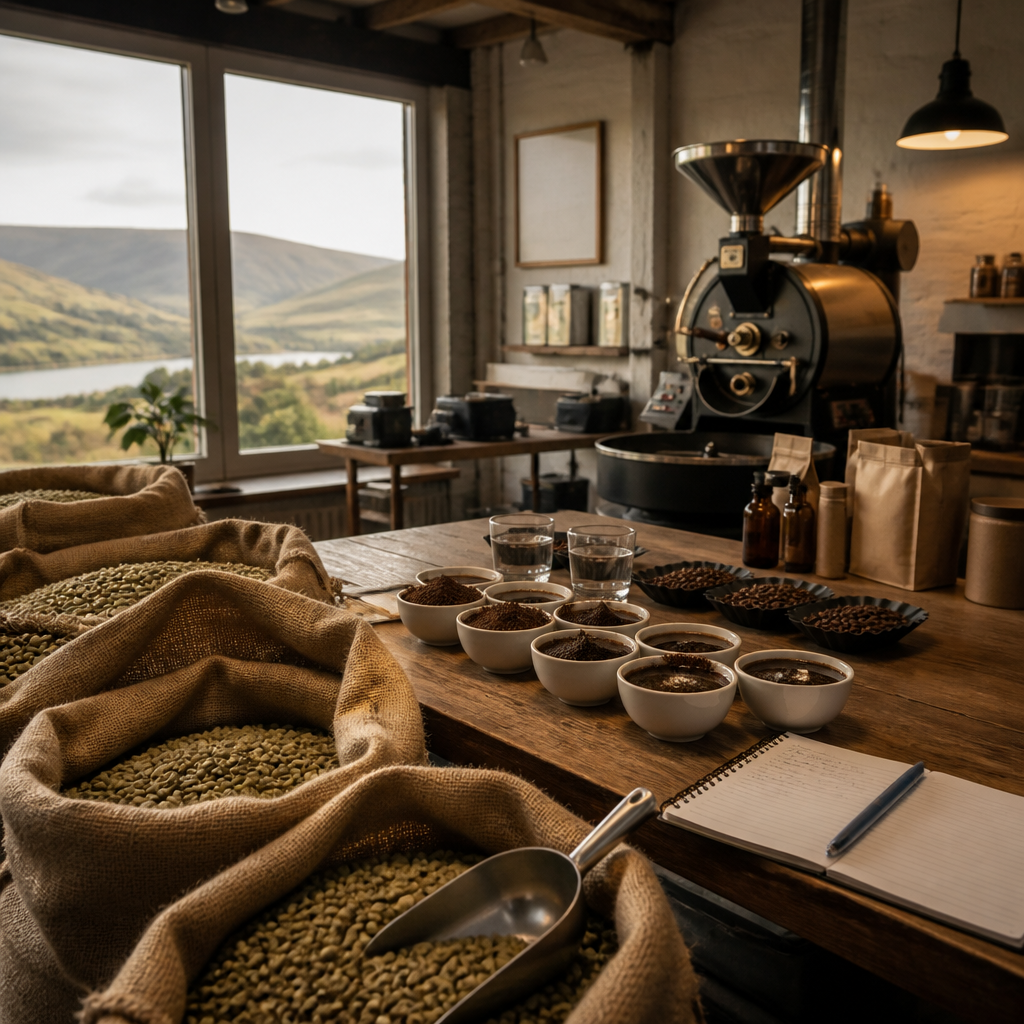
Before any blend ratio is set, each candidate origin is cupped individually. This tells the roaster exactly what they are working with from the current harvest, which matters because green coffee changes character year on year. A Colombian lot that was clean and bright last season may arrive this year with more fruit and less sweetness, requiring the roaster to adjust other components accordingly.
Pro tip: When evaluating a new origin for blend potential, cup it at the roast level you intend to use in the final blend, not at a generic medium. A bean that tastes excellent at a light-medium roast may become flat or one-dimensional when taken to the darker profile an espresso blend requires.
Pre-Blend vs. Post-Blend Roasting
Once origins are selected, the roaster faces a fundamental decision: blend the green coffees together before roasting, or roast each origin separately and combine them afterwards. Both approaches are legitimate, and both have genuine trade-offs.
The Case for Pre-Blending
Pre-blending, where the green beans are weighed and mixed before going into the roaster, simplifies production. There is one roast to manage rather than several. For roasters operating at volume with well-matched components, it is efficient and practical. The constraint is that different origins rarely want the same roast curve. A dense, high-grown Colombian needs more development time than a lower-density Brazilian natural. Roasting them together means one origin will be slightly under-developed while the other is exactly right.
The Case for Post-Blending
Post-blending, where each origin is roasted individually to its ideal profile and then combined in the target ratio, gives the roaster full control. The Colombian gets the curve it needs. The Brazilian gets a different curve. The result, when they are blended together, is a cup where every component is expressing its best self. This is the approach favoured by most specialty coffee blending operations, including those working at the level Farrer's occupies.
Post-blending also reduces waste in a commercial setting. If a roaster has already produced a batch of a particular origin for another purpose, the remainder can be incorporated into a blend rather than being run as a separate production.
| Approach | Advantages | Limitations |
|---|---|---|
| Pre-Blending (blend green beans before roasting) | Simpler production; one roast profile to manage; time-efficient at scale | Different origins rarely share the same ideal roast curve; one component may be slightly under or over-developed |
| Post-Blending (roast separately, then combine) | Each origin roasted to its ideal profile; maximum flavour development; reduces production waste; more consistent across harvests | More labour-intensive; requires managing multiple roast profiles and batch sizes simultaneously |
| Hybrid Approach (pre-blend some, post-blend others) | Allows certain compatible origins to share a roast while keeping outlier components separate; balances efficiency and quality | Requires detailed knowledge of each origin's roasting behaviour; adds complexity to production planning |
Building Balance: Body, Acidity, and Sweetness
The three-axis framework of body, acidity, and sweetness is the most practical way to think about blend construction. A well-balanced cup sits at a point where none of these three dimensions is absent and none is so dominant that it overshadows the others. Getting there is a matter of adjustment and iteration.
Body: Weight and Texture in the Cup
Body refers to the physical weight and texture of the coffee on the palate. A thin, watery cup has low body. A syrupy, almost chewy cup has high body. For espresso blends served with milk, higher body is generally desirable because it allows the coffee character to cut through dairy without becoming sour or thin. For filter blends meant to be drunk black, a medium body often serves better.
Acidity: Brightness, Not Sourness
Acidity in coffee is not the same as sourness. When properly developed, it is the quality that gives coffee its liveliness and perceived freshness. It is the difference between a cup that feels alive on the palate and one that sits flat. Managing acidity in a blend means knowing which origins carry it and at what ratio they should appear. Too much, and the cup tastes sharp or thin. Too little, and it tastes dull.
Sweetness: The Glue of a Good Blend
Sweetness in a roasted coffee comes primarily from caramelisation of sugars during roasting. It is what makes a cup feel approachable and round rather than aggressive. Brazilian and Central American coffees are reliable sweetness carriers. A blend that is high in acidity and body but lacks sweetness will taste unresolved, as though something is missing even if the individual components are impressive on their own.
Pro tip: When a test blend tastes technically correct but somehow unsatisfying, the problem is usually sweetness. Try increasing the proportion of a lower-grown, natural-processed component and cup again. In most cases, this closes the gap.
Arabica, Robusta, and What Each Brings
The choice between Arabica and Robusta, or a deliberate combination of both, is one of the most consequential decisions in blend design. The two species are not interchangeable, and the idea that Robusta is simply an inferior grade of coffee is a misreading of what it actually does well.
Arabica, grown at higher altitudes, produces a more complex, delicate cup with a defined acidity and a flavour range that extends from floral and fruity to nutty and chocolatey. The vast majority of specialty coffee is Arabica. Robusta, grown at lower altitudes, carries a bolder, earthier, fuller-bodied profile and contains roughly twice the caffeine of Arabica. It also produces a denser crema when used in espresso, which is why many Italian-style espresso blends include a Robusta component.
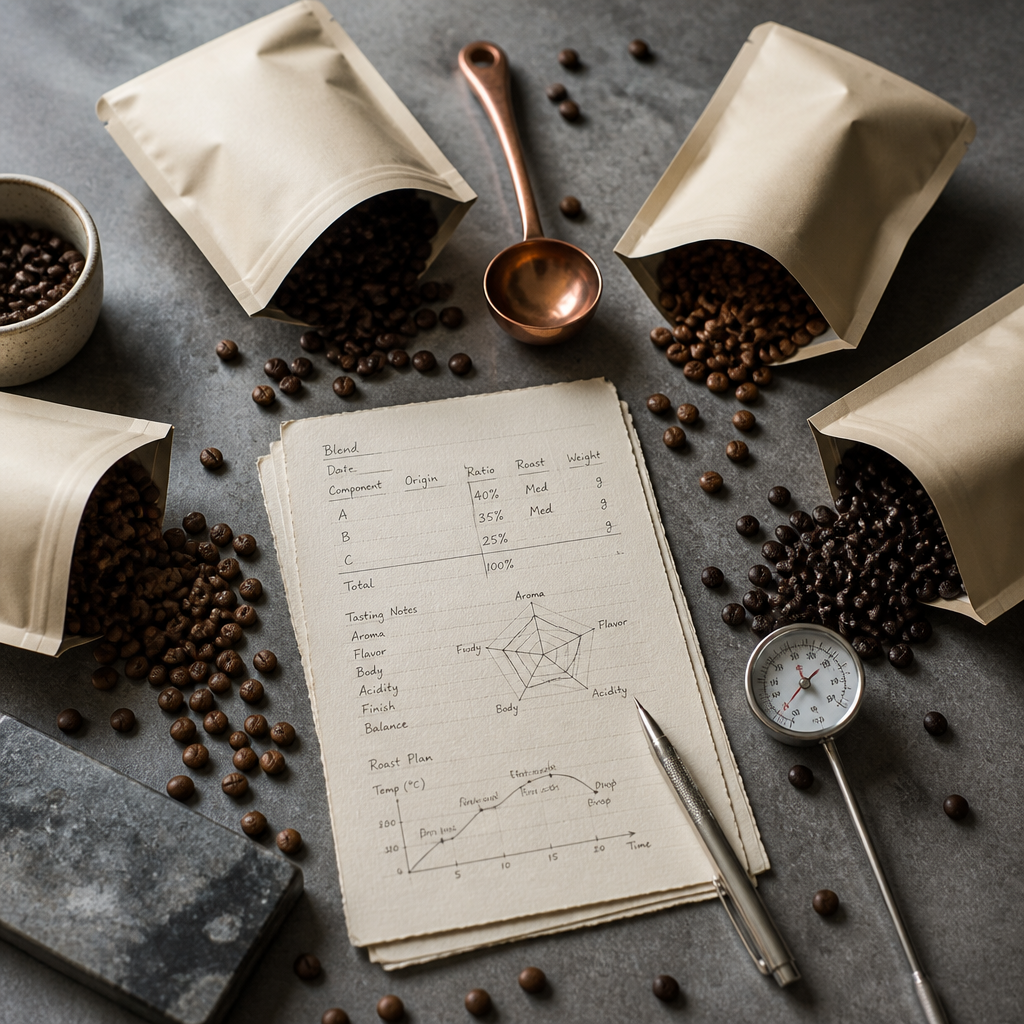
For specialty coffee blending in the UK, the most common approach is Arabica-dominant blends, with Robusta used sparingly, typically between 10% and 20%, to add structure and crema without introducing the harsh or rubbery notes that a poorly handled Robusta can produce. A high-grade Robusta from Uganda or India, properly sourced and correctly roasted, behaves very differently from a commodity-grade Robusta used as a cost-reduction measure.
Blends vs. Single Origins: Which One and When
The debate between blends and single origins is often framed as a quality question, with single origins positioned as the premium, serious choice. That framing misses the point. They are designed to do different things.
Single origins are expressive by nature. They reflect the terroir of a specific farm or region, and the best of them are genuinely extraordinary. But that expressiveness comes with variability. Each harvest shifts the flavour profile, sometimes subtly, sometimes significantly. A cafe serving a single origin espresso in October may find that the same coffee behaves differently in February when the next crop arrives. That is not a flaw, it is the nature of agricultural product.
Blends exist precisely to solve the consistency problem. A skilled roaster can adjust the component ratios each season to account for shifts in individual origin character, keeping the finished blend tasting the same even as the green coffee underneath it changes. For a cafe producing hundreds of espresso shots daily, or a home enthusiast who wants the same reliable result every morning, that consistency is not a compromise. It is the entire point.
The practical answer is to use both. Single origins reward attentive brewing and are ideal for filter methods where their distinct character can be appreciated fully. Blends, particularly those designed for espresso, deliver reliability, balance, and the body needed to hold up in milk-based drinks.
How Farrer's Approaches Blending
Farrer's has been roasting and blending coffee in Kendal since 1819, which means its core blends have been refined through more seasonal iterations than any other roaster in the UK. That kind of accumulated knowledge does not appear in a product description. It shows up in the cup, in the way a blend holds together across different brewing methods and different water profiles, and in the way it tastes consistent whether you order it in January or in August.
The approach at Farrer's is grounded in the same principles that define serious blending anywhere: careful sourcing from trusted partners, small-batch roasting that allows close attention to each lot, and a commitment to cupping rather than assuming. The Farrer's best blends guide gives a clear picture of how individual blends are constructed with specific goals in mind, whether that means a clean, high-roast profile or a sweeter, fuller-bodied option for espresso and milk.
What distinguishes a heritage roaster from a newer operation is not nostalgia. It is the depth of institutional knowledge built through doing the same work, carefully, across many decades. Farrer's story spans over two centuries, and the blending philosophy that developed in a Kendal market-town roastery has never needed to reinvent itself around trends. The work stays the same: source well, roast with attention, blend to a defined standard, and dispatch freshly.
For trade customers, including cafes and hospitality businesses looking for a reliable espresso blend that performs consistently across a commercial machine, this depth of experience matters practically, not just as a marketing story. A blend developed and refined over generations has had more problems identified and solved than any formulation put together in the last few years.
If you are new to Farrer's range, the best starting point is one of the established house blends rather than going straight to a single origin. The blends are designed to be approachable across a range of brewing equipment and skill levels, which is exactly the right place to begin understanding what a well-constructed blend can do.
Frequently Asked Questions
What is coffee blending and why do roasters do it?
Coffee blending is the process of combining two or more different coffees to create a cup that is more balanced, consistent, or complex than any single origin could produce alone. Roasters blend to achieve a defined flavour profile, to maintain consistency across harvests, and to build products that perform reliably across different brewing methods and environments.
Is blended coffee lower quality than single origin?
No. Quality is determined by the care that goes into sourcing, roasting, and blending, not by whether a coffee is a blend or a single origin. A thoughtfully constructed blend from high-grade components will always outperform a poorly sourced single origin. The best UK specialty roasters treat blending as skilled craft work, not as a shortcut.
What is the difference between pre-blending and post-blending?
Pre-blending means combining the green, unroasted beans before they go into the roaster. Post-blending means roasting each origin separately to its ideal profile and then combining them in the target ratio after roasting. Post-blending generally produces better results because each origin can be roasted to its own ideal, but pre-blending is used where production efficiency is the priority and the components share compatible roasting characteristics.
How many origins does a typical espresso blend contain?
Most espresso blends contain between two and four component origins. More than four becomes difficult to balance and can result in a muddy, unfocused cup. The most effective blends tend to have one or two foundation origins providing body and sweetness, and one or two character origins providing the brightness or complexity that makes the blend interesting.
How do roasters keep blends consistent when green coffee changes every season?
Skilled roasters cup each new harvest of their component origins before incorporating them into a blend. If a particular origin has shifted, the roaster adjusts the ratio of that component, or substitutes a similar-character lot, to keep the finished blend tasting the same. This is one of the most demanding parts of blend management and is where experience accumulated over many seasons makes a measurable difference.
What should I look for when choosing a coffee blend in the UK?
Look for transparency about the component origins, a clear description of the flavour profile it is designed to deliver, and information about how it is roasted. A roaster confident in their blending will tell you what the blend is built to do and why. Freshness matters too: a blend dispatched within days of roasting will always outperform one that has been sitting in a warehouse. Farrer's coffee range ships with next-day dispatch on qualifying orders, which makes freshness straightforward to achieve.
Can I brew an espresso blend as filter coffee?
Yes, and it often produces a satisfying cup. Espresso blends tend to be roasted slightly darker and carry more body, which can translate well to a French press or cafetiere where contact time is longer and body is a feature rather than a limitation. The result will taste different from what the blend was optimised for, but that does not make it a poor cup. Experiment with the grind and ratio to find what works best for your equipment.
Have you experimented with different coffee blends at home, or do you have a go-to that you would never change? We would love to hear what you look for in a balanced cup.
References
- A practical overview of pre-blending and post-blending approaches for coffee roasters
- What a coffee blend is and how roasters use components purposefully to build flavour
- An in-depth comparison of pre-blend and post-blend roasting decisions for specialty coffee
- Espresso-specific blending techniques and how precision requirements differ from filter blending
- How blends and single origins differ in consistency, flavour, and seasonal behaviour


