

Most people reach a point where the bag of coffee they grabbed during the weekly shop stops being satisfying and starts being adequate. The cup tastes the same every morning, which sounds fine until you realise "the same" means flat, slightly bitter, and forgettable.
If you have been drinking supermarket coffee out of habit rather than genuine enjoyment, that feeling is the earliest sign that you are ready to upgrade to specialty coffee. This guide lays out five clear signs, explains what is actually different about freshly roasted artisan beans, and gives you the practical information to make the switch with confidence.
Table of Contents
- Quick Takeaways
- Sign 1: Your Coffee Tastes Flat and One-Dimensional
- Sign 2: You Have No Idea When Your Beans Were Roasted
- Sign 3: You Are Adding Sugar or Milk Just to Make It Drinkable
- Sign 4: You Have Started Noticing What Good Coffee Actually Tastes Like
- Sign 5: You Care Where Your Food Comes From, But Not Your Coffee
- Specialty vs Supermarket: A Direct Comparison
- Frequently Asked Questions
- References
Quick Takeaways
| Key Insight | Explanation |
|---|---|
| Freshness is the biggest differentiator | Supermarket beans are often roasted months before you buy them. Specialty roasters dispatch within days of roasting, which means dramatically more flavour in the cup. |
| Flat bitterness is not coffee's fault | One-dimensional bitterness is a symptom of stale, commodity-grade beans, not an unavoidable feature of coffee itself. |
| Specialty coffee is graded against a strict standard | The Specialty Coffee Association (SCA) defines specialty grade as 80 points or above on a 100-point cupping scale, representing roughly the top 5% of beans worldwide. |
| Adding sugar masks a problem | If you need to sweeten your coffee to make it palatable, the beans or the staleness are the issue. Well-roasted fresh beans have natural sweetness. |
| Traceability matters beyond ethics | Specialty roasters know the farm, altitude, and processing method. That information correlates directly with consistent, complex flavour. |
| Whole beans stay fresher far longer than ground | Once ground, coffee oxidises rapidly. Buying whole beans and grinding before brewing is the single biggest practical upgrade most home drinkers can make. |
| Heritage roasters offer consistency you can trust | A roaster with over 200 years of practice has refined its blends over generations, not just for trend-chasing but for reliably excellent results in the cup. |
Sign 1: Your Coffee Tastes Flat and One-Dimensional
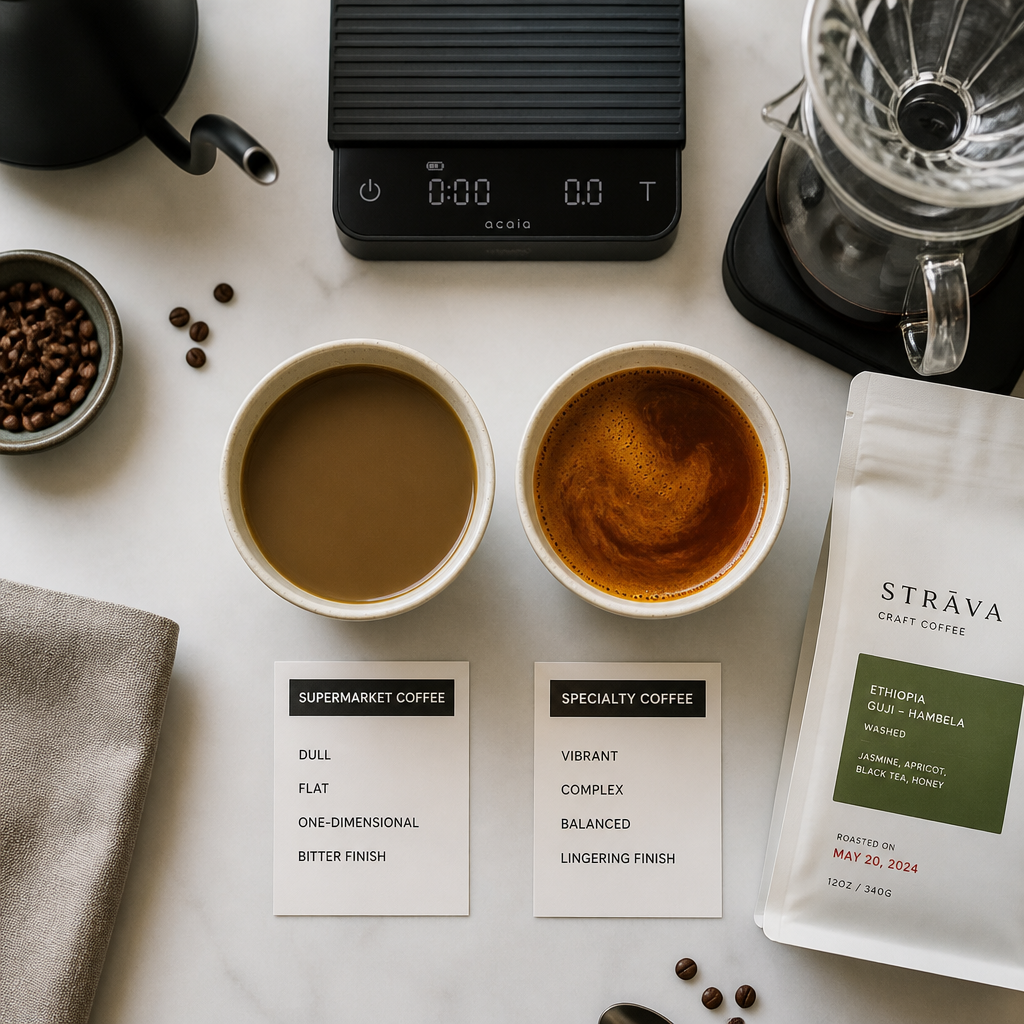
A well-sourced specialty roast carries distinct aroma notes such as dark chocolate, stone fruit, brown sugar, or citrus, and those notes shift as the cup cools. Commodity coffee tends toward flat bitterness. If every cup you make tastes like a vague approximation of "coffee" rather than something specific and interesting, that flatness is not your brewing technique. It is the beans.
Supermarket coffee is bought in large bulk volumes and must have a long shelf life to survive distribution, shelf stacking, and the weeks or months it sits before a customer picks it up. The result is a product optimised for durability, not flavour. Specialty coffee is the opposite: roasted in small batches with attention to what each origin actually tastes like, dispatched quickly, and consumed while it still has something to say.
Pro tip: Pro tip: Brew a cup of your current supermarket coffee and let it cool to room temperature. If the flavour disappears or turns harsh, that is stale coffee. A freshly roasted specialty bean reveals more character as it cools, not less.
What "flat" actually means in the cup
A balanced cup has both acidity and sweetness working together. Acidity adds brightness and complexity. Without it, coffee tastes dull and hollow. Supermarket beans, often dark-roasted to mask defects and over-aged during distribution, lose those volatile aromatic compounds long before they reach your cup. What you are left with is roast flavour and not much else.
Sign 2: You Have No Idea When Your Beans Were Roasted
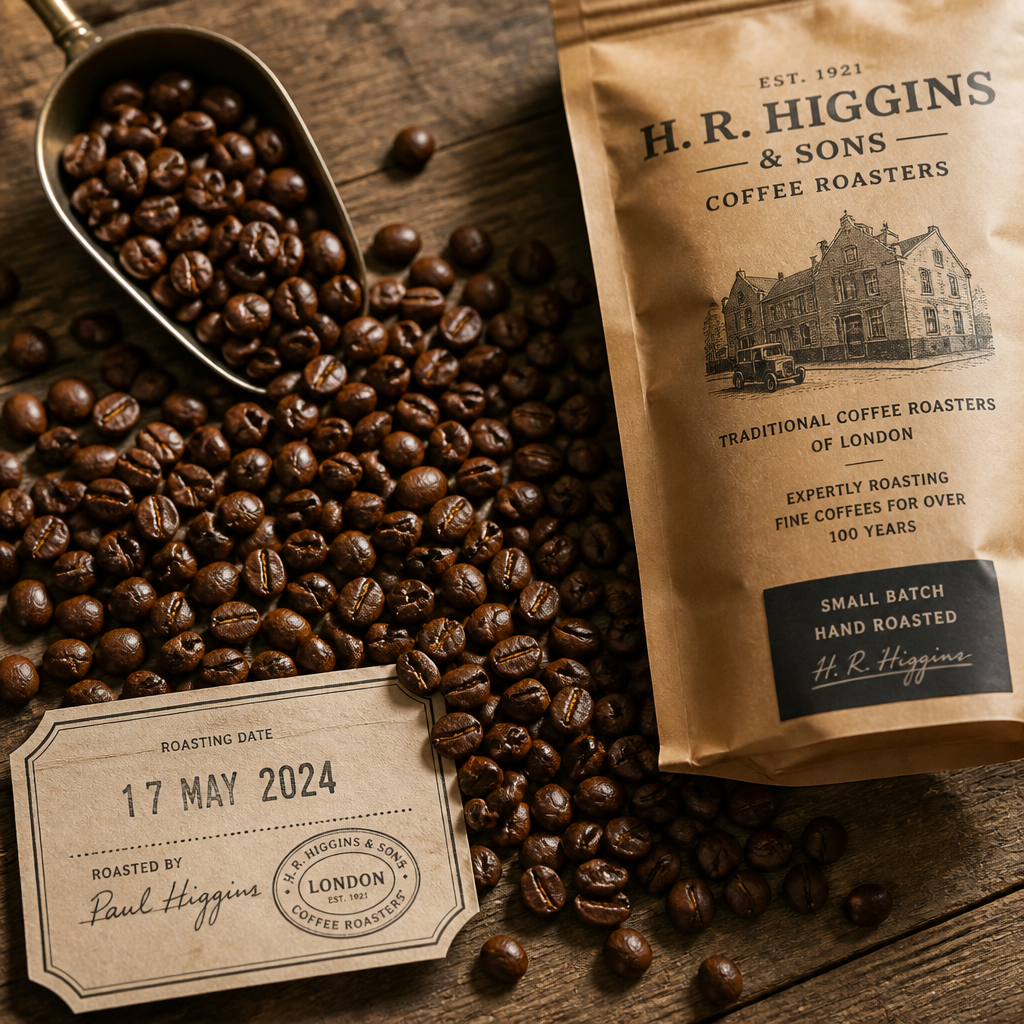
Pick up most supermarket coffee and look for a roast date. In most cases, you will find a best-before date, which tells you nothing useful. Best-before dates on coffee are typically set 12 to 24 months after packaging. That means a bag showing a best-before date 12 months away could have been roasted well over a year ago.
Specialty roasters print roast dates, not best-before dates, because freshness is central to what they are selling. Coffee reaches its peak flavour window roughly 3 to 14 days after roasting, and the ideal period for most brewing methods is within 2 to 4 weeks of the roast date. After 4 to 6 weeks, oxidation sets in, aromas fade, acidity flattens, and the coffee's character begins to disappear. Supermarket coffee is often 6 to 12 months old by the time it reaches your kitchen.
Why roast date transparency matters
When a roaster prints the roast date on the bag, they are making a commitment. They are telling you exactly how fresh the product is and inviting you to hold them accountable. Farrer's, roasting from the Lake District since 1819, dispatches orders with next-day delivery on orders over £35, meaning the gap between roastery and your kettle is measured in days, not months. That is a fundamentally different proposition to picking up a bag during a supermarket run.
Coffee is at its most expressive when it is relatively fresh. After roasting, the beans gradually lose carbon dioxide and volatile aromatic compounds, while their flavour continues to evolve.
Pro tip: When you buy from a specialty roaster, note the roast date on the bag and aim to use the beans within 3 to 4 weeks. Store them in an airtight container away from light and heat. Do not refrigerate whole beans as condensation accelerates staling.
Sign 3: You Are Adding Sugar or Milk Just to Make It Drinkable
There is nothing wrong with milk or sugar in coffee. But if you are adding them because the coffee is unpleasant without them, that is a signal worth examining. Bitterness and harshness that require masking are almost always a quality and freshness problem, not a personal taste preference.
Freshly roasted specialty beans, particularly those from quality origins selected by skilled roasters, carry natural sweetness from the bean's sugars and complex carbohydrates. Careful roasting enhances rather than destroys those qualities. The result is a cup that is softer, cleaner, and more rounded even without additions. Many people who switch to specialty coffee find they gradually reduce or eliminate sugar because the coffee no longer needs it.
What happens when you roast for flavour vs roast for shelf life
Commodity roasters tend to use darker roast profiles partly to homogenise the flavour of mixed, lower-grade beans and partly because dark roasting slows the most obvious signs of staleness in the short term. The problem is that dark roasting destroys a great deal of the bean's inherent character. Specialty roasters match the roast profile to the origin, which means lighter or medium roasts that let the bean speak for itself. The sweetness, the brightness, and the complexity you find in a well-roasted fresh bean are not there by accident. They are there because someone made deliberate choices at every stage from farm to roastery.
Sign 4: You Have Started Noticing What Good Coffee Actually Tastes Like
You had a great cup somewhere and it changed the baseline. Maybe it was in a cafe, at a friend's house, or somewhere unexpected. You noticed it because it was different from what you usually drink. You cannot quite describe it, but it was brighter, cleaner, more interesting. That moment of noticing is the clearest sign that your palate has already moved past what supermarket coffee can offer.
This is not snobbery. It is the same process that happens when you eat genuinely good bread after years of sliced white, or taste fresh pasta versus dried. Once you know the difference, the gap becomes obvious. Specialty coffee rewards attention in a way that commodity coffee simply cannot, because the layers of flavour are genuinely there to find.
How the SCA grading system explains the quality gap
The Specialty Coffee Association defines specialty grade as coffee scoring 80 points or above on a 100-point cupping scale, representing roughly the top 5% of beans worldwide. Coffees scoring 85 to 89.99 are graded Excellent, and anything 90 and above is graded Outstanding.
Supermarket coffee is not graded this way because it is purchased as a commodity based on price and volume, not sensory quality. When you buy from a roaster who selects beans against this kind of standard, you are buying from a fundamentally different part of the supply chain.
Farrer's approach as a roaster with over 200 years of experience reflects exactly this kind of considered selection. The blends and single origins in their range are chosen because of what they deliver in the cup, not because of price per tonne on a commodity exchange.
Sign 5: You Care Where Your Food Comes From, But Not Your Coffee
If you buy free-range eggs, choose bread from a local bakery, and read labels on your fruit and vegetables, but you have never thought about where your coffee comes from, that inconsistency is worth addressing. Coffee is one of the most traded agricultural commodities in the world, and the conditions under which it is grown and processed vary enormously.
Specialty roasters focus on traceability as a core part of their business. They know the country, the region, the farm, and often the processing method for every bean they sell. That is not just an ethical consideration, though it matters ethically. Traceability also correlates directly with quality. Farmers who are paid fairly for their crop have the resources and incentive to invest in quality at the production stage. Specialty roasters who visit farms and work directly with importers select beans that reflect genuine care at origin.
What traceability looks like in practice
A specialty roaster's product listing will typically tell you the country of origin, the region or farm, the variety of coffee plant, the altitude at which it was grown, and the processing method used to remove the fruit from the bean. Each of those variables shapes the flavour in the cup. Compare that to a supermarket bag that says "a blend of Arabica and Robusta beans," which tells you almost nothing about what you are actually drinking or where it came from.
Farrer's range of freshly roasted coffee blends reflects genuine curation. Whether you are exploring a specific origin or looking for a reliable everyday blend, the selection is built around what delivers quality and character in the cup, not around what fills shelf space.
Specialty vs Supermarket: A Direct Comparison
To make the differences concrete, the table below compares three approaches to buying coffee in the UK. This is not a question of budget alone. It is a question of what you are actually getting for your money.
| Factor | Supermarket Coffee | Specialty Artisan Roaster (e.g. Farrer's) |
|---|---|---|
| Roast date transparency | Rarely printed. Best-before dates only, often 12-24 months out. | Roast date printed on bag. Beans roasted to order or in small batches, dispatched within days. |
| Bean quality grading | Commodity grade. Purchased on price and volume. Not SCA-cupped. | Specialty grade. Beans selected on sensory quality. Many score 80+ on the SCA 100-point scale. |
| Flavour complexity | Flat, one-dimensional. Roast notes dominate. Little origin character. | Complex, layered. Origin character preserved. Notes of chocolate, fruit, caramel, or floral depending on origin. |
| Sourcing transparency | Generic: "blend of Arabica and Robusta." Country of origin sometimes listed. | Farm, region, altitude, variety, and processing method typically listed per product. |
| Freshness on purchase | Often 6-12 months old at point of sale. | Roasted within days to 2-3 weeks before delivery. Peak flavour on arrival or shortly after. |
| Ethical considerations | Supply chain opaque. Price-driven purchasing offers little leverage for producer welfare. | Direct or transparent relationships with importers. Producers paid fairly for quality, which funds better farming practices. |
The price difference between commodity supermarket coffee and quality freshly roasted beans is real. But the cost per cup, when measured against what you are actually drinking, is far smaller than the retail shelf price suggests. Specialty coffee also means you are likely to drink less, more slowly, and with more attention. That changes the economics considerably.
If you are ready to make the switch, Farrer's full coffee range is a natural starting point. Over 200 years of roasting experience, hand-packed in the Lake District, with next-day dispatch on orders over £35. You also have the option to explore brewing equipment if you want to upgrade your method alongside your beans. A burr grinder, in particular, makes an immediate difference to what you taste in the cup.
Pro tip: If you are new to specialty coffee, start with a well-crafted blend rather than a single origin. Blends are designed for consistency and approachability. Once you know what you enjoy, single origins let you explore specific regions and processing styles in more depth. Farrer's blend range is a good place to calibrate your palate before going further.
Frequently Asked Questions
Is specialty coffee significantly more expensive than supermarket coffee?
Yes, there is a price difference, but it is smaller per cup than the retail bag price suggests. When you are buying genuinely fresh beans in whole-bean form, you use them more efficiently, waste less, and often drink smaller quantities because the flavour is more satisfying. The gap narrows further when you compare the per-cup cost against cafe prices for similarly quality coffee.
Do I need special equipment to make specialty coffee taste good at home?
Not necessarily. Good beans make a noticeable difference even with a standard cafetiere or filter machine. The single biggest equipment upgrade you can make is a burr grinder. Grinding fresh, just before brewing, preserves volatile aromatics that disappear within minutes of grinding. If you already have a grinder, better beans will immediately show their character. Farrer's stocks brewing equipment if you want to take your setup further.
What does "freshly roasted" actually mean in practical terms?
It means the beans were roasted recently and are within their peak flavour window. Most coffee reaches its best flavour between 3 and 14 days after roasting, and the ideal drinking window is within 2 to 4 weeks of the roast date. Supermarket coffee is routinely 6 to 12 months old at point of sale. Freshly roasted means you are buying beans that are still degassing and still full of aromatic compounds that translate into flavour and aroma in the cup.
What is the difference between specialty coffee and artisan coffee?
"Specialty coffee" has a specific technical definition: beans scoring 80 or above on the SCA's 100-point cupping scale. "Artisan coffee" is a broader, less regulated term that typically describes coffee roasted in small batches with attention to craft, origin, and flavour rather than volume and price. In practice, the two terms often overlap. Both stand in contrast to commodity-grade coffee, which is bought and blended primarily on price with little attention to sensory quality or traceability.
How do I know if a roaster is genuinely specialty grade?
Look for roast date transparency on the bag, sourcing information that goes beyond country of origin, small-batch roasting practices, and a curated range that reflects genuine selection rather than shelf-filling. Roasters who train their staff, offer tasting guidance, and can tell you the processing method for each bean they sell are operating in a different category to those who simply repackage commodity coffee in appealing packaging.
Can I try specialty coffee without committing to a large order?
Yes. Many specialty roasters, including Farrer's, offer a range of bag sizes so you can explore different blends and origins without committing to a large quantity upfront. Starting with a 250g bag of a well-regarded blend is a low-risk way to understand the difference that freshness and quality make. If you are ordering over £35, next-day dispatch means the beans arrive in peak condition.
Is loose leaf tea from a specialty roaster similarly better than supermarket tea?
Yes, the same principles apply. Supermarket tea bags typically contain lower-grade fannings and dust rather than whole or broken leaf tea. A loose leaf tea from a specialist supplier, selected and packed with the same attention as specialty coffee beans, delivers significantly more flavour, aroma, and nuance. Farrer's loose leaf tea range is curated with the same philosophy as the coffee: quality, freshness, and genuine character in the cup.
If you have already made the switch from supermarket to specialty coffee, or you are on the verge of doing it, share what prompted the change in the comments. The moment people describe most often is a single cup that made everything else taste ordinary.
References
- How specialty coffee is graded using the SCA 100-point cupping system
- Specialty coffee definition, grading standards, and SCA scoring criteria
- Supermarket coffee beans vs specialty coffee beans: a practical comparison
- Why freshly roasted specialty beans differ from supermarket commodity coffee
- Coffee freshness explained: roast dates, storage, and peak flavour windows


