

Some coffees earn their reputation through marketing. The No 1 Blend coffee from Farrer's earned its reputation through two centuries of people choosing it again and again. That is not a figure of speech.
Farrer's has been roasting in Kendal since 1819, and the No.1 Blend recipe is one of the originals, passed down through generations with the kind of care that no rebranding exercise can manufacture. If you have ever wondered why this particular light roast coffee keeps appearing in order histories and referrals from existing customers, the answer is in the cup.
This article breaks down exactly what the No.1 Blend is, how to get the most from it, and why it continues to outperform more recent arrivals in the premium coffee space.
Table of Contents
- Quick Takeaways
- What Is the No.1 Blend?
- Flavour Profile Explained
- Why Light Roast Coffee Matters
- How to Brew the No.1 Blend
- No.1 Blend vs. Other Roast Approaches
- Why Customers Keep Coming Back
- Who Should Order the No.1 Blend
- Frequently Asked Questions
- References
Quick Takeaways
| Key Insight | Explanation |
|---|---|
| Light roast with real body | The No.1 Blend is described as a light roast but delivers a well-rounded, satisfying body, not the thin or sharp character that puts some drinkers off lighter coffees. |
| 100% Arabica sourced from two regions | Beans come from South and Central America (rich, smooth, nutty) and Asia (clean, complex, sweet, chocolate notes), giving the blend its layered character. |
| Recipe dating back over 200 years | The No.1 Blend recipe is one of Farrer's originals from the 1819 founding era, not a modern reformulation designed to chase trends. |
| Versatile across brew methods | Available pre-ground for cafetiere, filter, AeroPress, moka pot, and espresso, as well as whole bean, so it adapts to however you brew at home. |
| Freshness is the real differentiator | Farrer's roasts in small batches and dispatches with next-day shipping on qualifying orders, meaning the coffee arrives fresh rather than warehouse-aged. |
| Best first brew: cafetiere at 94-96°C | This temperature and method extracts sweetness and floral top notes without over-extracting the body, giving the clearest read on the blend's actual character. |
| Subscription saves 10% | Regular roastery delivery locks in a 10% saving and removes the friction of reordering, keeping your supply genuinely fresh on a schedule you control. |
What Is the No.1 Blend?
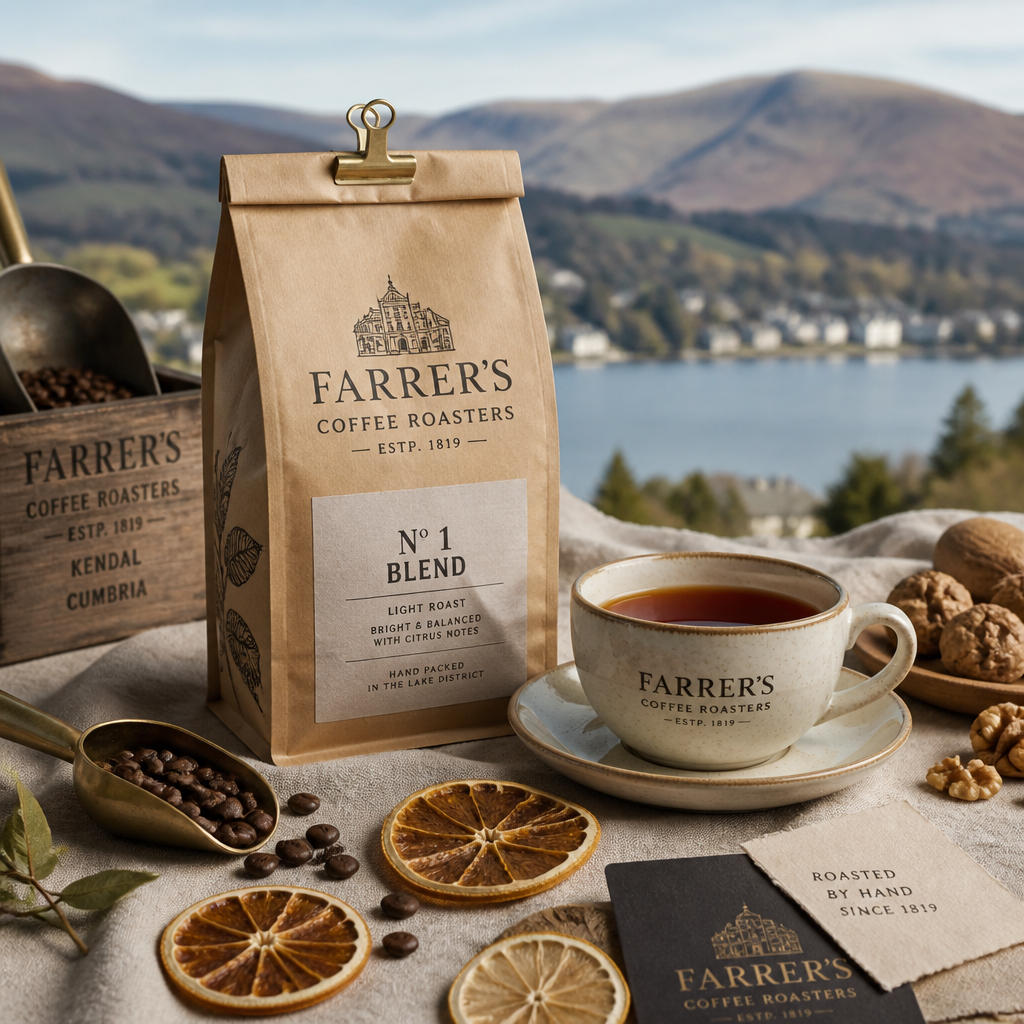
The No.1 Blend is Farrer's flagship product. It is a signature Arabica coffee built on beans sourced from trusted growers across South and Central America and Asia, then roasted in small batches at the Farrer's roastery in Kendal, described as the gateway to the Lake District. The blend has been part of the Farrer's offering since the founding era of 1819, which means it predates most coffee companies that exist today by well over a century.
What makes this significant is not the age itself but what survival over that timescale implies. A recipe does not persist through changing tastes, wars, and economic upheaval by accident. It persists because it works. The No.1 Blend has been refined within those original parameters rather than reinvented, which is a meaningful distinction in a category where reformulation often means cost-cutting disguised as improvement.
The blend is available in whole bean form for those who grind at home, and in a range of pre-ground settings, including coarse for cafetiere, medium for filter, medium-fine for AeroPress and moka pot, and fine for espresso. That range of formats reflects a genuine commitment to accessibility rather than the assumption that everyone owns a grinder.
Flavour Profile Explained
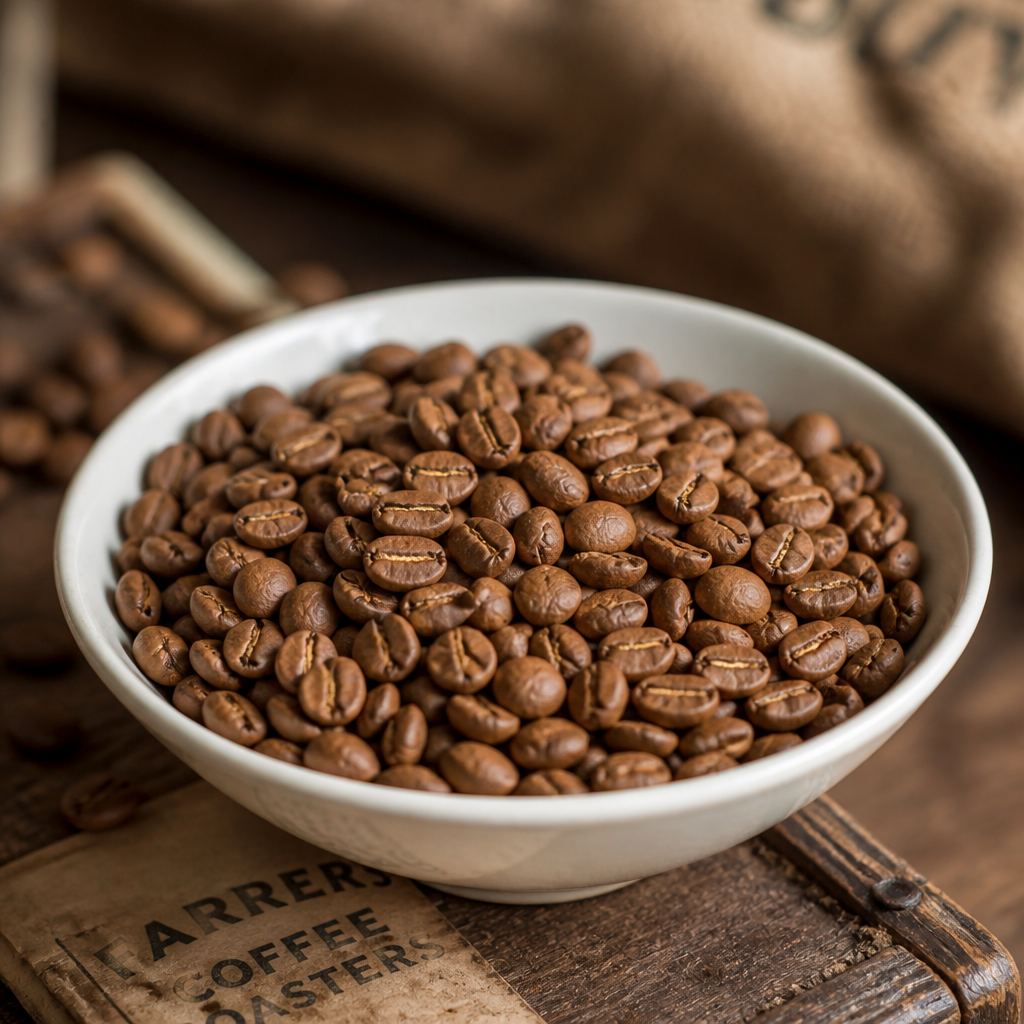
The official tasting notes for the No.1 Blend are chocolate, nuts, and a gentle citrus lift. These three elements are not decorative. They map directly onto what you taste through different stages of the cup, and understanding that structure helps you brew it better.
The Chocolate and Nut Foundation
The South and Central American component of the blend contributes what Farrer's describes as a rich, smooth, and nutty backbone. This is the body of the cup, the part that registers as satisfying and rounded rather than sharp or thin. Milk chocolate and Brazil nut are the reference points on the Farrer's tasting wheel for this element. These notes emerge most clearly at the mid-palate and carry through to the finish.
The Citrus Top Notes
The Asian component brings what Farrer's describes as a clean, complex character with a sweet finish and chocolate notes of its own. It also contributes the citrus top notes that give the blend its brightness. These are not sour or aggressive, they are a lift, arriving at the top of the sip rather than dominating the aftertaste. This is what makes the No.1 Blend work in filter and cafetiere formats where acidity is more exposed than in espresso.
A well-constructed coffee blend is one where each component earns its place by contributing something the other origins cannot provide alone. The No.1 Blend's combination of South American body and Asian clarity is a textbook example of that principle in practice.
The overall character is smooth and satisfying, with a well-rounded body and a bright, balanced finish. It is not a challenging cup designed to demonstrate roasting complexity at the expense of drinkability. It is a cup that rewards attention without demanding it.
Why Light Roast Coffee Matters
Light roast coffee is frequently misunderstood by home brewers who associate lighter roasts with weakness or sourness. The No.1 Blend is a corrective to both assumptions. A lighter roast preserves more of the origin character in the bean. The sugars are less caramelised, the cell structure retains more moisture, and the volatile aromatic compounds that give coffee its brightness and complexity have not been driven off by extended heat exposure.
The practical result is a cup with more distinct flavour notes and a cleaner finish than a dark roast of the same beans would produce. Dark roasting is a legitimate choice for specific brewing purposes, particularly espresso with milk, but it is not an upgrade. It is a transformation, and what it creates is fundamentally different from what a lighter roast preserves.
Pro tip: Light roasts are denser than dark roasts and require slightly more energy to extract. If you are brewing the No.1 Blend on a pour-over or filter machine, use water at 93 to 96 degrees Celsius rather than the lower end of the range some guides suggest. Under-extracted light roast coffee tastes weak and sour, not because the coffee is bad but because it needed more heat to release its flavour compounds properly.
The No.1 Blend sits in territory that Farrer's describes as a light roast with bright, lively character. The word "lively" is useful here. It signals that the brightness is active and present rather than aggressive or sharp. This is a coffee designed to be interesting in the cup, not just inoffensive.
How to Brew the No.1 Blend
The No.1 Blend is described by Farrer's as best suited to filter and cafetiere brewing, and that recommendation reflects the flavour profile accurately. The blend's citrus top notes and chocolate foundation both express well in immersion and drip brewing methods where the extraction is gentler and the flavour is less compressed than in espresso.
Cafetiere (French Press)
Use the coarse grind option if ordering pre-ground, or grind coarse at home. Water temperature should be 94 to 96 degrees Celsius. A four-minute steep is the baseline. This method extracts the sweetness and floral top notes without over-extracting the body, which gives you the clearest read on what the blend actually tastes like before you start experimenting with other methods.
Filter and Pour-Over
Use the medium grind setting. Filter brewing opens up the citrus brightness more than cafetiere because the paper filter removes more of the oils that can mute high notes. If you find the No.1 Blend too forward in acidity through a pour-over, try a lower brew ratio (more coffee per gram of water) rather than adjusting temperature, which tends to create other extraction problems.
Espresso
The No.1 Blend works as an espresso, particularly for those who prefer a lighter-bodied, more acidic shot or who are brewing for filter-style flat whites rather than traditional milk drinks. Use the fine grind setting and aim for standard extraction parameters. Be aware that the acidity will be more pronounced in an espresso format than in filter, which some drinkers prefer and others find too forward for morning drinking.
Pro tip: If you are ordering the No.1 Blend in whole bean form, note the roast date when it arrives and allow at least five to seven days before brewing your first cup. Fresh-roasted coffee contains CO2 that disrupts extraction. A short rest period after roasting allows the gas to dissipate naturally, producing a more even, sweeter extraction across all brew methods.
No.1 Blend vs. Other Roast Approaches
Choosing between a light roast like the No.1 Blend and other roast profiles is not a matter of one being better than another in absolute terms. It is a question of what you are trying to achieve in the cup and through which brewing method. The table below compares the No.1 Blend against a medium-dark and a dark roast approach to make those differences concrete.
| Characteristic | No.1 Blend (Light Roast) | Medium-Dark Roast | Dark Roast (e.g. Italian Style) |
|---|---|---|---|
| Acidity | Bright, present, citrus-lifted | Balanced, moderate | Low, largely suppressed |
| Body | Well-rounded, satisfying | Full, heavier | Heavy, dense |
| Flavour notes | Chocolate, nuts, citrus | Caramel, toffee, darker chocolate | Bitter chocolate, roast, tar-like at extremes |
| Best brew method | Cafetiere, filter, pour-over | Espresso, AeroPress, moka pot | Espresso, milk-based drinks |
| Performance with milk | Pleasant but more delicate | Good, stands up to milk well | Designed to cut through milk |
| Origin character preserved | High, clearly expressed | Moderate | Low, roast dominates origin |
| Ideal drinker | Filter coffee drinkers, those transitioning from tea, morning cup drinkers | Espresso drinkers who want some complexity | Milk drink drinkers, traditional espresso fans |
Why Customers Keep Coming Back
Customer retention for a specific coffee blend is usually explained by one of three things: habit, value, or genuine quality. The No.1 Blend generates repeat orders across all three, but the third is the one that matters most and is the hardest to manufacture.
The freshness point is not a marketing claim. Farrer's roasts to order in small batches and dispatches with next-day shipping on orders over £35. The practical result is that the coffee arriving at your door is genuinely fresh in a way that warehouse-distributed coffee, regardless of brand, cannot be. Oxidation begins the moment a bean is roasted, and the difference between coffee roasted days ago and coffee roasted weeks ago is not subtle. It is the difference between a cup that tastes alive and one that tastes flat.
The recipe itself is also a genuine reason for loyalty. Many customers discover the No.1 Blend through Farrer's café on Stricklandgate in Kendal, where it has been the consistent best seller, and then order it online to continue drinking it at home. That pipeline from in-person experience to online subscription is one of the most reliable forms of customer acquisition in speciality coffee because the quality does the convincing before the order is placed.
Verified customer reviews on Feefo consistently highlight freshness, consistency, and the quality of the product alongside service reliability. Comments noting that the coffee is "always fresh" and that service is "always correct" point to something more durable than novelty. These are customers measuring against their own previous orders and finding the product meets or exceeds their expectations each time. That is a high bar to maintain over a customer lifetime, and Farrer's 4.9/5 rating reflects it.
There is also the question of what the No.1 Blend does not do. It does not over-promise a flavour profile so specific that you need a perfectly calibrated setup to taste it. It does not require a particular brewing method to be enjoyable. It is a coffee that performs across contexts, which is exactly what a flagship blend should do.
Who Should Order the No.1 Blend
The No.1 Blend is a strong choice for three distinct groups. First, home drinkers who brew by cafetiere or filter and want a classic coffee with real flavour rather than generic supermarket character. The blend's combination of chocolate, nut, and citrus gives it enough complexity to reward attention without requiring specialist equipment.
Second, tea drinkers who are moving toward coffee or who drink both. The brightness of the No.1 Blend and its clean, non-bitter finish make it approachable for people whose palate is calibrated to the lighter, more aromatic character of quality loose leaf tea. Farrer's position as a premium tea and coffee roaster means many customers come to the No.1 Blend through the tea range, and the transition is genuinely smooth.
Third, trade buyers running cafes or hospitality settings that serve a filter coffee option alongside espresso. Some trade buyers use the No.1 Blend as their filter offering while running a darker espresso blend for milk drinks. This is a legitimate and practical approach for venues whose customers span both preferences. Farrer's trade supply options, combined with next-day dispatch on qualifying orders, make restocking straightforward without requiring large advance stock holds.
Pro tip: If you are introducing the No.1 Blend to a trade setting, brew a calibration batch on your specific equipment before committing to a full menu rotation. The same coffee behaves differently through batch brew equipment and through a manual pour-over station. Establish your preferred ratio and temperature on your actual kit before it goes to customers.
For anyone unsure whether to start with the No.1 Blend or one of Farrer's other offerings, the blend's versatility makes it the lower-risk starting point. You can always move toward darker roasts from there, but starting with the lightest approachable option gives you the clearest foundation for understanding your own preferences.
Frequently Asked Questions
Is the No.1 Blend actually a light roast?
Farrer's describes the No.1 Blend as a light roast with bright, lively character. In practice, it sits on the lighter end of the spectrum but delivers a well-rounded body that distinguishes it from very light specialty single origins. It is not thin or sharp. It has enough structure to be satisfying while preserving the origin character of its Arabica beans from South and Central America and Asia.
What does the No.1 Blend taste like?
The primary flavour notes are chocolate, nuts, and citrus. The chocolate and nut character comes from the South and Central American component of the blend and forms the body of the cup. The citrus notes arrive as a lift at the top of the sip rather than a dominant acidity. The overall impression is smooth, satisfying, and well-balanced, with a clean finish rather than a lingering bitterness.
Which brewing method works best for the No.1 Blend?
Farrer's recommends filter and cafetiere as the primary brewing methods. These formats give the blend space to express its brightness and chocolate notes without the compression of espresso. That said, the No.1 Blend can be pulled as an espresso, particularly for drinkers who prefer a lighter, more acidic shot. For a first brew, a cafetiere at 94 to 96 degrees Celsius with a four-minute steep gives the clearest read on the blend's actual character.
Can I use the No.1 Blend for espresso and milk drinks?
Yes, but with some caveats. The No.1 Blend's lighter roast means its more delicate citrus and floral notes will be muted when mixed with milk. It works pleasantly in flat whites and lattes, but if milk-based drinks are your primary format, a darker roast blend designed around espresso culture will produce more assertive results through dairy. The No.1 Blend is at its best as a black filter or cafetiere coffee, or as a lighter-style espresso served without milk.
How fresh is the No.1 Blend when it arrives?
Farrer's roasts in small batches and dispatches with next-day shipping on orders over £35. This means the coffee arriving at your door is genuinely fresh, roasted within days rather than weeks of delivery. This is a meaningful distinction from warehouse-distributed coffee where the time between roasting and receipt can be difficult to track. Pre-ground coffee stales significantly faster than whole beans due to increased surface area exposure to oxygen, so whole bean with home grinding will give you the longest window of peak flavour.
Is the No.1 Blend suitable for trade buyers and cafes?
Yes. The No.1 Blend is served daily in Farrer's own café in Kendal and has been a consistent bestseller there. Trade buyers typically use it as a filter coffee option alongside a darker espresso blend for milk drinks. Farrer's next-day dispatch on qualifying orders makes restocking manageable without requiring large on-site stock holds, which is practical for smaller hospitality operations.
What is the difference between ordering whole bean and pre-ground?
Whole bean gives you the longest shelf life and the most control over your extraction, since grind size is the primary variable in coffee brewing. Pre-ground is available in a range of settings matched to specific brew methods: coarse for cafetiere, medium for filter, medium-fine for AeroPress and moka pot, and fine for espresso. If you do not have a grinder, the pre-ground options are genuinely useful, but store opened pre-ground coffee in an airtight container and use it within two to three weeks of opening for best results.
Have you brewed the No.1 Blend, and which method gave you the best results? Share your experience below so other home brewers can learn from what you found.
References
- Farrer's No.1 Blend product page: flavour notes, origins, and available grind formats
- Farrer's guide comparing the No.1 Blend and Italian Blend across brewing method, roast level, and use case
- Verified customer reviews of Farrer's coffee and service via Feefo
- Farrer's guide to freshly roasted coffee and how to choose between blends
- Farrer's No.1 Blend description including brew method recommendations and tasting notes


