

Most independent cafes make the same supplier mistake: they choose whoever offers the lowest per-kilo price, then wonder why their regulars stop coming back.
The UK's specialty coffee market is worth over £1.4 billion and growing, yet a significant number of independent operators are still sourcing from suppliers with no roasting heritage, no technical support, and no skin in their success.
That is changing. A growing number of cafes, restaurants, and hospitality businesses are actively moving toward a trade coffee supplier UK with demonstrable roasting expertise, and the reasons are far more practical than sentimental.
Table of Contents
- Quick Takeaways
- Why Independent Cafes Are Walking Away From Generic Suppliers
- What 200 Years of Roasting Expertise Actually Means in Practice
- Wholesale Coffee for Cafes: What Professional Grade Really Looks Like
- Barista Training UK: Why Your Supplier Should Offer It
- Coffee for Restaurants UK: The Case for a Specialist Trade Partner
- Comparing Trade Coffee Supplier Approaches
- Frequently Asked Questions
- References
Quick Takeaways
| Key Insight | Explanation |
|---|---|
| Heritage roasting produces measurably consistent flavour profiles | Suppliers who have refined blends over generations have dialled in roast curves that newer operations simply cannot replicate quickly. Consistency matters for menu repeatability. |
| Next-day dispatch directly affects cafe cash flow | Holding large coffee stock ties up working capital. A supplier offering next-day dispatch on orders over £35 lets cafes order closer to need, reducing waste and improving margins. |
| Barista training from your supplier reduces staff turnover costs | When a supplier provides hands-on barista training, staff competence improves and costly extraction errors drop. This is a direct operational benefit, not a perk. |
| Professional-grade coffee changes average spend per customer | Cafes serving specialty-grade coffee command premium pricing. A higher quality base product justifies a higher menu price that customers accept when the cup delivers. |
| Trade accounts with roastery access build product knowledge | Suppliers offering roastery experience days give cafe staff first-hand understanding of the product. Staff who understand origin and roast can sell more effectively. |
| Freshness is not a marketing claim, it is a technical requirement | Coffee degrades rapidly after roasting. Hand-packed, freshly roasted wholesale coffee for cafes outperforms pre-packed commodity coffee in extraction yield and cup quality. |
| Supplier reputation directly affects cafe reputation | A 4.9/5 verified customer rating from a supplier signals reliability. When a trade customer recommends their supplier to another operator, that credibility transfers. |
Why Independent Cafes Are Walking Away From Generic Suppliers
The pattern is consistent across the UK hospitality sector. A cafe launches using whatever coffee supplier offered the easiest onboarding, usually a large commercial roaster with templated trade terms. Within twelve months, the owner is dealing with inconsistent bag weights, flavour drift between batches, zero technical support, and a sales rep who visits once a year with promotional material rather than practical help.
In practice, the switch to a specialist trade coffee supplier UK is rarely triggered by a single dramatic failure. It is a gradual accumulation of friction: a batch that tastes flat, a delivery that arrives late before a weekend rush, a question about grind settings that goes unanswered. These are operational problems, not philosophical ones, and operators solve them the same way they solve any operational problem: they find a better supplier.
The UK's independent cafe sector is particularly price-sensitive, but experienced operators understand that the cheapest per-kilo price rarely produces the lowest total cost. When you factor in staff time spent compensating for inconsistent coffee, customer complaints, and the slower table turnover that comes from cups that need remaking, a higher-quality wholesale source typically delivers better unit economics.
Pro tip: Before switching suppliers, ask your current one for the roast date on their last three deliveries. If they cannot provide it or the gap between roast and delivery exceeds ten days consistently, freshness is already costing you extraction quality and cup consistency.
What 200 Years of Roasting Expertise Actually Means in Practice
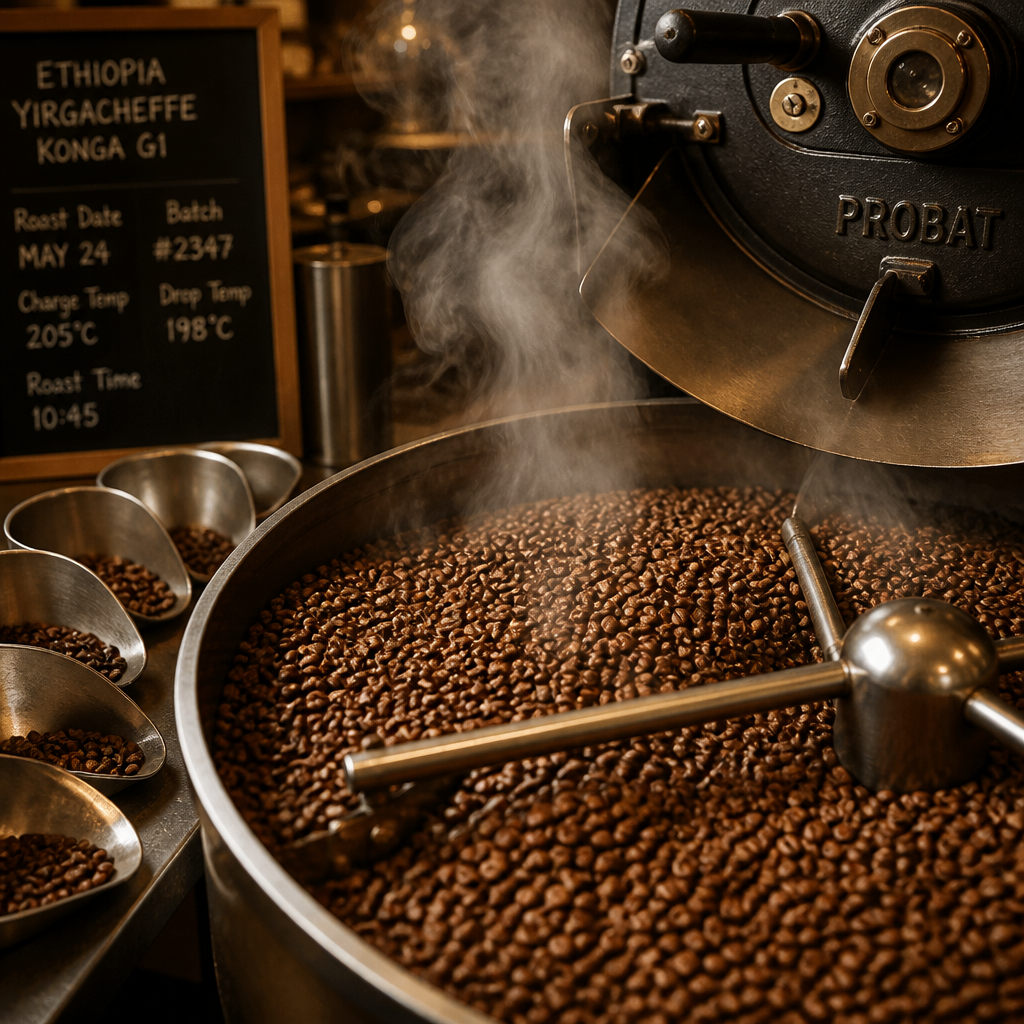
Heritage in the coffee industry is sometimes used as wallpaper, a nice story on a website that does not translate into anything a cafe owner actually experiences. But there is a technical reality behind a roaster that has been operating for over two centuries from the Lake District: institutional knowledge about blend construction, green bean selection, and roast profiling that takes decades to accumulate and cannot be shortcut.
Farrer's, established over 200 years ago, is the UK's oldest coffee roaster. That history means their core blends have been refined through more market feedback cycles, more equipment generations, and more raw material variations than any newer roaster has had the opportunity to process.
A blend that has been sold commercially for decades has had its recipe pressure-tested by real cafes serving real customers across changing tastes and changing water chemistry across the country.
Why Blend Stability Matters for Cafe Operations
A cafe's regulars return partly because the flat white tastes the same every Tuesday morning. When the coffee changes, even subtly, that familiarity breaks. Suppliers who do not have deep roasting experience produce more batch-to-batch variation because their roast profiles are still being adjusted. An experienced roaster has already solved for the variables that a newer operation is still learning to manage.
The data consistently shows that customer retention in independent hospitality is driven more by consistency than by novelty. A cafe that serves the same excellent cup every day will outperform one that occasionally delivers a remarkable cup and regularly delivers a mediocre one.
"Consistency is what separates a good cafe from a great business. The best coffee in the world served inconsistently is still an inconsistent business." - James Hoffmann, World Barista Champion and coffee author
The Lake District Roastery Advantage
Operating from the Lake District rather than a metropolitan warehouse is not a quirk. It reflects a roastery that has built its operation around craft production rather than volume throughput. Hand-packing, which Farrer's uses, preserves freshness in ways that automated high-volume lines cannot, because the coffee spends less time between roasting and sealing.
Pro tip: When evaluating a potential trade coffee supplier UK, ask specifically about their roast-to-pack interval. Anything beyond 48 hours for espresso blends should prompt further questions about their storage and degassing process.
Wholesale Coffee for Cafes: What Professional Grade Really Looks Like
The term professional-grade coffee is used loosely in trade marketing. In practice, it has a specific meaning: coffee sourced, roasted, and packed to a standard that performs reliably under the extraction pressures, temperatures, and volumes that a commercial cafe environment demands. Consumer-grade coffee, even good consumer-grade coffee, is not optimised for this.
A common mistake among newer cafe operators is to source coffee from a roaster whose retail offering they personally enjoy, without checking whether that roaster's wholesale operation runs to the same standard. Retail and wholesale are different supply chains, and a roaster whose 250g retail bags are excellent may not have the infrastructure to deliver consistent quality in 5kg and 25kg trade quantities.
What to Look for in a Trade Account
Professional-grade wholesale coffee for cafes should come with a clearly stated roast date on every bag, a defined grind recommendation for the intended brewing method, and technical support when extraction problems arise. These are not luxury additions. They are the baseline for a functional trade relationship.
Farrer's trade offering covers coffee blends, loose leaf teas, and hot chocolate, meaning a cafe can consolidate multiple hot drink categories into a single supplier relationship. For restaurant operators especially, reducing the number of supplier relationships reduces administrative overhead significantly.
Next-day dispatch on orders over £35 is operationally significant. It means a cafe experiencing an unexpected high-volume week does not have to choose between compromising quality and apologising to customers. The supply chain is responsive enough to absorb real hospitality volatility.
Barista Training UK: Why Your Supplier Should Offer It
Most cafes lose more money to poor extraction than to any other single variable in their cost structure. Under-extracted espresso wastes coffee by producing weak shots that get remade. Over-extracted shots produce bitter cups that customers do not return for. Both outcomes are training problems, not equipment problems, and a trade supplier who does not offer barista training UK is leaving its trade customers exposed to a cost they do not see on any invoice.
Farrer's addresses this directly through barista training programmes and roastery experience days. The experience day format is particularly valuable because it takes cafe staff out of their usual environment and into the source context of the product they serve every day. A barista who has seen coffee being roasted, understands the relationship between roast level and extraction behaviour, and has had hands-on training from specialists will make fewer errors and will also communicate the product more effectively to customers.
The Staff Turnover Dimension
The UK hospitality sector has a documented high staff turnover rate. According to the Office for National Statistics, the accommodation and food services sector consistently records among the highest annual turnover of any industry in the UK. Every new hire represents a training cost, and if a cafe's coffee supplier does not offer training support, that cost falls entirely on the operator.
A supplier who provides structured barista training effectively subsidises part of that onboarding cost. For a cafe turning over three or four baristas a year, this is not a minor benefit. It is a material reduction in the hidden cost of running a hospitality business.
Pro tip: When negotiating a trade account, ask explicitly what training support is included and whether it covers new staff onboarding or only initial setup. A supplier who offers ongoing training access is demonstrably more invested in your operational success than one who provides a single session at sign-up.
Coffee for Restaurants UK: The Case for a Specialist Trade Partner
Restaurants have a specific coffee problem that cafes sometimes do not: coffee is not their primary revenue category, which means it often receives less operational attention than it deserves. A poor espresso at the end of a well-executed meal is a disproportionately memorable negative. Research from the British coffee industry consistently highlights that the post-meal coffee experience has an outsized effect on overall dining satisfaction scores.
For coffee for restaurants UK, the priorities are slightly different from a standalone cafe. Consistency and simplicity of operation matter more than single-origin diversity.
A restaurant kitchen team does not have the same depth of coffee expertise as a dedicated cafe crew. The right wholesale coffee supplier for a restaurant provides blends that are forgiving under variable extraction conditions, technical guidance that is accessible to non-specialists, and enough range to offer a credible filter and espresso option without requiring a full specialist menu.
Consolidating Hot Drink Supply for Hospitality Businesses
Farrer's product range, which includes premium teas alongside coffee and hot chocolate, makes it a genuinely practical single-source trade partner for hospitality operators. A restaurant managing separate supplier relationships for coffee, tea, and hot chocolate is adding invoice volume, delivery scheduling complexity, and relationship management overhead that a single specialist supplier eliminates.
The Lake District heritage also carries a specific marketing benefit for restaurants that emphasise provenance and quality. Being able to tell a guest that the espresso they are drinking comes from the UK's oldest coffee roaster is a story with genuine substance. It is the kind of detail that ends up on menus and in staff training scripts because it gives front-of-house teams something authentic to say.
Comparing Trade Coffee Supplier Approaches
Not all trade relationships are structured the same way. The differences between a large commercial roaster, a specialty-focused newer roaster, and an established heritage roaster like Farrer's are worth examining directly rather than glossing over with vague claims about quality.
| Supplier Type | Strengths for Trade Customers | Limitations for Independent Cafes |
|---|---|---|
| Large commercial roaster (e.g., Lavazza model) | High volume capacity, strong brand recognition, wide distribution network | Limited flexibility on blend customisation, lower roast freshness due to scale, minimal personalised trade support, brand dominance can overshadow cafe identity |
| Newer specialty roaster (e.g., Origin Coffee model) | Strong single-origin focus, modern roast profiles, social media credibility | Less blend stability due to fewer years of refinement, trade infrastructure still maturing, barista training support variable, limited non-coffee product range for hospitality consolidation |
| Heritage specialist roaster (Farrer's model) | Over 200 years of blend refinement, freshly hand-packed product, next-day dispatch, barista training and roastery experience days, full hot drink range for trade consolidation, 4.9/5 verified customer rating | Smaller marketing budget than major commercial brands, Lake District base means physical proximity is relevant mainly for northern UK operators seeking in-person roastery visits |
The comparison above makes clear that the choice of trade supplier is a strategic operational decision, not a branding preference. Each model suits different types of hospitality business, but for independent cafes prioritising consistency, freshness, and genuine trade support, the heritage specialist model has structural advantages that the other two cannot easily replicate.
Frequently Asked Questions
What makes Farrer's different from other trade coffee suppliers in the UK?
Farrer's is the UK's oldest coffee roaster, operating for over 200 years from the Lake District. This longevity means their blends have been refined through more commercial feedback cycles than any newer roaster. Their trade offering combines freshly roasted, hand-packed coffee with next-day dispatch on orders over £35, barista training programmes, and roastery experience days. Few other trade coffee supplier UK options combine that level of heritage with that level of operational support.
How does freshness affect the coffee a cafe serves its customers?
Coffee degrades through oxidation, CO2 loss, and moisture absorption from the moment it is roasted. For espresso, the optimal extraction window is typically between 5 and 30 days post-roast. Wholesale coffee that sits in a warehouse for weeks before dispatch arrives already outside that window. Freshly roasted, promptly dispatched coffee extracts more evenly, produces better crema, and delivers the flavour complexity that justifies a premium menu price.
Is barista training from a supplier worth using if I already have experienced staff?
Yes, and for a specific reason: experienced staff who learn directly from the roaster develop a product-specific understanding that general barista training does not provide. They learn how the particular blends they are using behave under different extraction parameters, which makes their adjustments more precise. It also means they can communicate the coffee's story to customers, which affects perceived value and average spend.
What is the minimum order for a trade account with a supplier like Farrer's?
Farrer's offers next-day dispatch on orders over £35, which is notably accessible for smaller independent cafes that cannot always commit to large minimum orders. This structure benefits operators who want to maintain freshness by ordering more frequently in smaller quantities, rather than holding large stock that degrades over time.
Can a restaurant use the same trade coffee supplier as a cafe?
Yes, and there are specific advantages to doing so. A supplier like Farrer's that offers a full range of hot drinks, including coffee, tea, and hot chocolate, is well suited to restaurant trade accounts because it allows the operator to consolidate multiple product categories under one supplier relationship. This reduces administrative complexity and often improves delivery scheduling reliability.
How do I evaluate whether switching trade coffee suppliers is worth the operational disruption?
Calculate the hidden costs you are currently absorbing: remade shots, customer complaints about inconsistency, staff time spent compensating for variable extraction, and the cost of training new staff without supplier support. In practice, most cafe operators who go through this calculation find that the disruption of switching is significantly smaller than the ongoing cost of staying with a supplier that is not delivering consistent quality and genuine trade support.
If you run an independent cafe or restaurant and have made the switch to a specialist trade coffee supplier, share what drove the decision and what changed operationally after you made the move.
References
- UK coffee market size and specialty coffee sector growth data from Statista
- Forbes coverage of independent hospitality business trends and supplier relationships
- Office for National Statistics data on UK hospitality sector staff turnover rates
- Food Standards Agency guidance on commercial food and beverage product quality standards in the UK
- British Retail Consortium reports on UK food and drink trade supply chain performance


