

Most people who spend serious money on freshly roasted coffee then store it in a way that actively destroys it. A bag left open on the counter, a container parked next to the hob, beans dumped into the freezer alongside last month's peas.
The result is a flat, stale cup that bears almost no resemblance to what the roaster intended. If you want to know how to store coffee in a way that actually preserves the flavour, the aroma, and the complexity you paid for, the answer comes down to understanding four enemies: oxygen, moisture, heat, and light.
Table of Contents
- Quick Takeaways
- Why Freshness Degrades Faster Than You Think
- The Four Enemies of Fresh Coffee
- Choosing the Right Container
- Where to Store Your Coffee at Home
- Whole Bean vs Ground: Storage Rules Change Completely
- Comparing the Three Most Common Storage Methods
- Coffee Freshness Tips for Trade Buyers and Hospitality Businesses
- Frequently Asked Questions
- References
Quick Takeaways
| Key Insight | Explanation |
|---|---|
| Oxygen is the primary spoiler | Once roasted coffee is exposed to air, oxidation begins immediately and noticeably degrades flavour within days, not weeks. |
| Airtight containers beat sealed bags | Resealable foil bags lose effectiveness after repeated opening. A dedicated airtight canister with a one-way valve preserves freshness significantly longer. |
| Whole beans stay fresh roughly twice as long as ground coffee | Grinding dramatically increases surface area exposed to oxygen. Buy whole beans and grind only what you need per brew. |
| Room temperature beats the freezer for daily use coffee | Freezing works for long-term bulk storage only. Daily thawing and refreezing introduces moisture condensation that ruins the grind and the cup. |
| Keep coffee away from heat sources | Storing coffee above or beside an oven or kettle accelerates staling. Ambient temperature above 25°C measurably shortens shelf life. |
| Buy in quantities you will use within two to four weeks | For freshly roasted coffee like Farrer's hand-packed blends, smaller and more frequent orders beat bulk buying for cup quality. |
| Roast date matters more than best before date | Look for a roast date on the bag. Coffee is at peak flavour between 7 and 28 days post-roast. A best before date alone tells you very little. |
Why Freshness Degrades Faster Than You Think
The moment coffee beans leave the roaster, a chemical countdown begins. During roasting, carbon dioxide builds up inside the bean structure.
This CO2 actually acts as a short-term protective barrier, pushing oxygen away from the volatile aromatic compounds responsible for flavour. But that CO2 gradually off-gasses, and once it is gone, oxygen moves in. The process is called oxidation, and it is ruthless.
Research published in food science literature consistently shows that ground coffee loses a detectable portion of its aromatic compounds within 15 minutes of grinding.
Whole beans fare better, but even they show meaningful flavour degradation after two weeks in non-ideal storage. This is not conjecture. This is measurable chemistry.
"Staling in roasted coffee is primarily driven by oxidation and moisture absorption. The rate of staling doubles with every 10°C increase in storage temperature." - Adapted from research published by the Journal of Agricultural and Food Chemistry
The practical implication is clear. Freshly roasted coffee from a roaster like Farrer's, dispatched within days of roasting, arrives at its peak. What you do in the next two to four weeks determines whether that quality survives to the cup.
The Four Enemies of Fresh Coffee
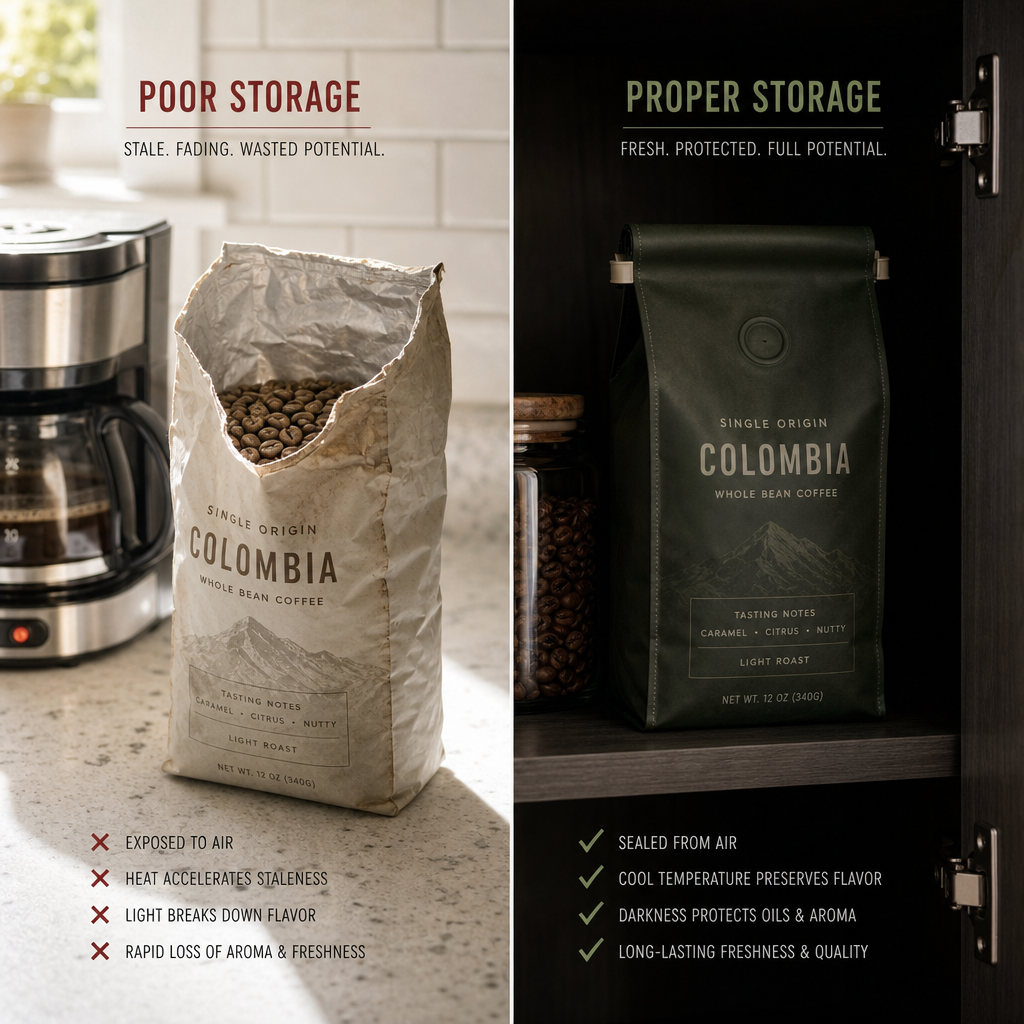
Understanding what actually damages coffee gives you a clear framework for every storage decision you make. There are exactly four factors, and each one acts independently. Neutralise all four and your coffee stays significantly fresher for longer.
Oxygen
Oxygen reacts with coffee's aromatic oils and triggers oxidation. This is the single biggest cause of staleness. A bag left open overnight will taste noticeably flatter by morning. An airtight seal is non-negotiable, not optional.
Moisture
Coffee is hygroscopic, meaning it actively absorbs moisture from the surrounding air. Humidity accelerates staling and can introduce mould in extreme cases. A common mistake is storing coffee in a cool, damp cupboard under the sink. It feels logical because it is dark, but the moisture exposure makes it one of the worst spots in the kitchen.
Heat
Heat speeds up every chemical reaction, including the ones that degrade flavour. Storing coffee on a shelf directly above a kettle or beside a cooker is essentially slow-cooking your beans into blandness. Consistent cool temperatures preserve aromatic integrity far more effectively.
Light
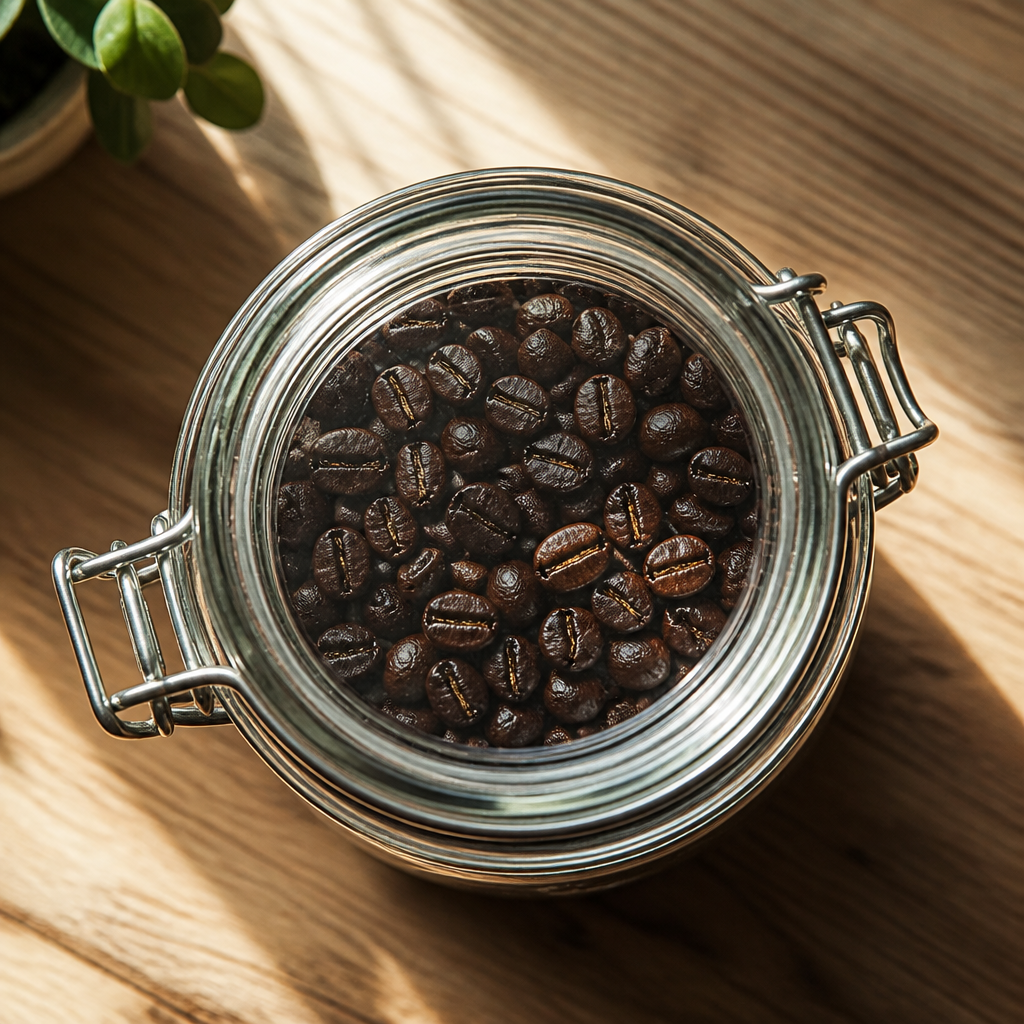
UV light degrades organic compounds. Clear glass containers on a sunny windowsill are attractive but damaging. Opaque containers or storage in a dark cupboard are always the better choice. Light exposure is often the most overlooked of the four enemies, particularly for people who use decorative glass canisters.
Pro tip: If you already use a glass container, store it inside a dark cupboard rather than on an open shelf. You get the aesthetic when you open the cupboard, and the beans stay protected when you close it.
Choosing the Right Container
The container you choose matters almost as much as where you put it. Not all airtight containers are created equal, and some popular options sold specifically for coffee storage have meaningful design flaws.
One-Way Valve Containers
The best containers for freshly roasted coffee include a one-way CO2 valve. This allows the off-gassing CO2 from recently roasted beans to escape without letting oxygen in. Without this valve, freshly roasted beans can pressurise a sealed container and force open the lid, or the consumer ends up leaving the container cracked open, defeating the purpose entirely.
Ceramic and Stainless Steel Canisters
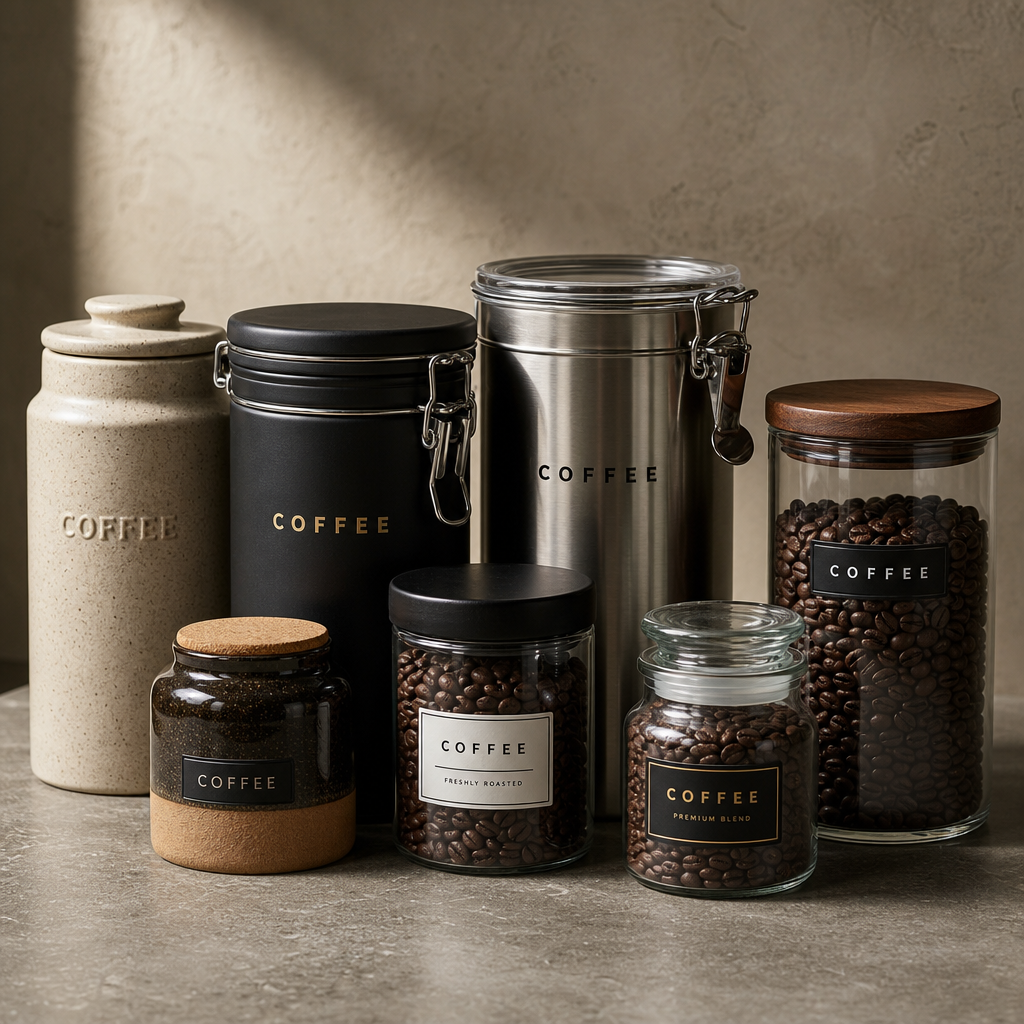
Ceramic and stainless steel containers with proper gasket seals are excellent for coffee that has already had a few days to off-gas post-roast. They are opaque, non-reactive, and when sealed correctly, they block all four staling enemies effectively. Avoid plastic containers for anything other than short-term transport. Plastic is porous and often carries residual odours that transfer to the coffee.
The Original Bag
A well-designed coffee bag with a one-way valve and a resealable zip-lock is actually a very good short-term container, provided you press out excess air before sealing and keep it in a cool, dark spot. Farrer's bags are designed with exactly this in mind. The mistake is leaving the bag open between uses or crushing it loosely closed without removing the air pocket trapped inside.
Pro tip: After taking out your daily dose of beans, press the bag flat from the bottom up to expel air before resealing. This takes three seconds and meaningfully extends freshness compared to loosely folding the top over.
Where to Store Your Coffee at Home
Location in the kitchen matters far more than most people assume. The three places where coffee most commonly ends up are also three of the worst places for it.
The Counter Next to the Kettle
Convenient, but exposed to heat every time the kettle boils, ambient light for most of the day, and air every time the container is opened without fully resealing. Avoid this if you care about what ends up in the cup.
The Fridge
A persistent myth. The fridge is actually one of the worst places for daily-use coffee. It is damp, full of competing food odours that coffee absorbs readily, and the temperature cycling every time the door opens creates condensation inside the container. Ground coffee stored in the fridge will absorb fridge odours within 24 to 48 hours. This is a measurable and irreversible degradation.
A Cool, Dark Cupboard Away from Appliances
This is the correct answer for home storage. A cupboard that does not share a wall with the oven, that stays below 20°C year-round, and that is opened only when needed. In practice, a pantry cupboard or a kitchen cabinet on an exterior wall tends to meet all these criteria. Consistent temperature and darkness are the two non-negotiables.
The Freezer for Long-Term Storage
Freezing is a legitimate strategy, but only for bulk quantities you will not be opening regularly. If you receive a large shipment of Farrer's freshly roasted coffee and cannot use it all within four weeks, portion it into airtight freezer bags, remove all air, and freeze. Remove a portion only when you are ready to use it, and allow it to come to room temperature in the sealed bag before opening. Never return thawed coffee to the freezer.
Whole Bean vs Ground: Storage Rules Change Completely
The difference between storing whole beans and pre-ground coffee is not a matter of degree. It is a fundamentally different challenge, and the approach needs to reflect that.
Grinding shatters the bean's structure and increases total surface area by a factor of roughly several hundred times. Every additional surface is a new contact point for oxygen and moisture. The data is consistent here.
Ground coffee goes stale roughly twice as fast as whole beans under identical storage conditions. Some flavour scientists argue the differential is even greater for lighter roasts with more volatile aromatic compounds.
The practical recommendation is direct. Buy whole beans and grind immediately before brewing. If you are buying pre-ground coffee, whether for convenience or because you do not own a grinder, you need to be more aggressive about storage. Smaller quantities, properly sealed, consumed within ten days of opening. Pre-ground coffee sitting in a half-empty bag for three weeks is a coffee experience that does not do justice to the roaster's work.
Farrer's offers both whole bean and ground options across their blend range. If you are serious about freshness, the whole bean option paired with a decent burr grinder is the combination that most reliably delivers what the roastery intended.
Comparing the Three Most Common Storage Methods
| Storage Method | Ideal Use Case | Key Limitations |
|---|---|---|
| Airtight canister (ceramic or stainless) in a dark cupboard | Daily-use whole beans or ground coffee consumed within 2 to 4 weeks of roast date | Requires discipline to keep sealed and stored away from heat sources. Not suitable for beans still actively off-gassing without a valve. |
| Original roaster bag resealed with air pressed out | Short-term storage of 1 to 2 weeks for freshly roasted coffee still in the off-gassing phase | Bag integrity degrades with repeated opening and resealing. Not as reliable as a dedicated container beyond two weeks. |
| Airtight freezer bag in the freezer | Bulk storage of whole beans not intended for use within 4 weeks | Requires portioning before freezing. Any moisture condensation from improper thawing ruins the batch. Not suitable for ground coffee. |
Coffee Freshness Tips for Trade Buyers and Hospitality Businesses
The stakes are higher in a commercial setting. If you are running a cafe, restaurant, or hospitality business, coffee freshness tips are not just about personal preference. They affect customer retention, review scores, and the consistency that trade accounts depend on.
In practice, the most common error in commercial environments is buying in volume to reduce per-unit cost, then storing the excess poorly and serving stale coffee for the final week or two of a large order.
The per-unit saving is immediately cancelled by the reputational cost of inconsistent quality. A 4.9/5 rating, like the one Farrer's maintains from verified customers, is built cup by cup. It is undone the same way.
For trade buyers, the smarter approach is to work with a roaster who can provide regular smaller deliveries on a frequency that matches your actual usage. Farrer's next-day dispatch for orders over £35 makes this practically achievable for most cafe and restaurant operations without needing to hold large reserves.
Calculate your weekly usage accurately, order on a rolling weekly or bi-weekly schedule, and store each delivery properly in a cool, dark, airtight environment near the point of use but away from the espresso machine's heat.
Also train your team on the basics. Staff who understand why the coffee should be kept sealed and away from steam will maintain those standards without needing constant supervision. A five-minute briefing during onboarding pays dividends across every service period.
Pro tip: Label each container with the roast date and the date the bag was opened. When a member of staff can see at a glance that a batch was opened eight days ago, they know to prioritise using it before opening the next one. This simple habit eliminates the most common cause of stale coffee in busy commercial kitchens.
Frequently Asked Questions
How long does freshly roasted coffee stay fresh once opened?
Whole bean freshly roasted coffee stays at its best for approximately two to four weeks after the bag is opened, provided it is stored in an airtight container in a cool, dark location. Ground coffee degrades faster, and you should aim to use it within seven to ten days of opening. The roast date on the bag is your most reliable reference point.
Is it safe to store coffee in the freezer?
Yes, but only for long-term storage of unopened or carefully portioned batches. The danger is moisture condensation that forms when frozen coffee is repeatedly thawed and refrozen. If you freeze coffee, portion it before freezing, remove all air from the container, and never return a thawed portion to the freezer. Thaw in the sealed container at room temperature before opening.
Does the type of roast affect how quickly coffee goes stale?
Yes. Lighter roasts contain more volatile aromatic compounds and tend to show flavour degradation sooner than dark roasts under identical storage conditions. However, dark roasts have more surface oils that can go rancid when exposed to oxygen. Both benefit equally from proper airtight storage. The principles are the same regardless of roast level.
Can I store coffee in a clear glass jar on the counter?
Not if you want to preserve flavour. Clear glass exposes coffee to light, which degrades aromatic compounds. A counter position also exposes it to ambient heat and repeated air contact every time you open the jar. If you prefer a glass container for practical reasons, keep it inside a dark cupboard between uses rather than on an open shelf.
How do I know if my coffee has gone stale?
Stale coffee has a flat, papery, or cardboard-like smell rather than the bright, complex aroma of fresh beans. When brewed, it produces little to no crema on espresso and tastes dull, bitter, or one-dimensional. If the bag you open does not immediately smell interesting, the storage conditions have already done damage. This is the clearest signal to adjust your storage method for the next purchase.
Should I grind coffee ahead of time to save effort in the morning?
This is one of the most common compromises people make, and it consistently produces worse coffee. Grinding the evening before, or batch-grinding for the week, means you are brewing stale grounds regardless of how well the original beans were stored. If time is the constraint, a fast burr grinder makes fresh grinding on demand practical. The quality difference is immediately noticeable.
Does brewing equipment near the storage area cause any problems?
Yes. Espresso machines, kettles, and filter machines all generate heat and steam. Storing coffee directly above or beside any of these appliances exposes it to fluctuating temperatures and moisture. Keep your coffee storage location at least half a metre away from any active heat source and in a sealed cabinet rather than on an open shelf near the brew station.
What is your current coffee storage setup, and has changing it ever made a noticeable difference to the flavour in your cup? Share your experience below.
References
- Food science research on oxidation and coffee staling mechanisms
- Forbes coverage of the specialty coffee industry and consumer quality expectations
- Statista data on global coffee consumption trends and market behaviour
- Food Standards Scotland guidance on food storage best practices
- Ahrefs blog research on consumer search intent around food and beverage quality topics


